Does the New Testament Support Pacifism?
October 17th, 2011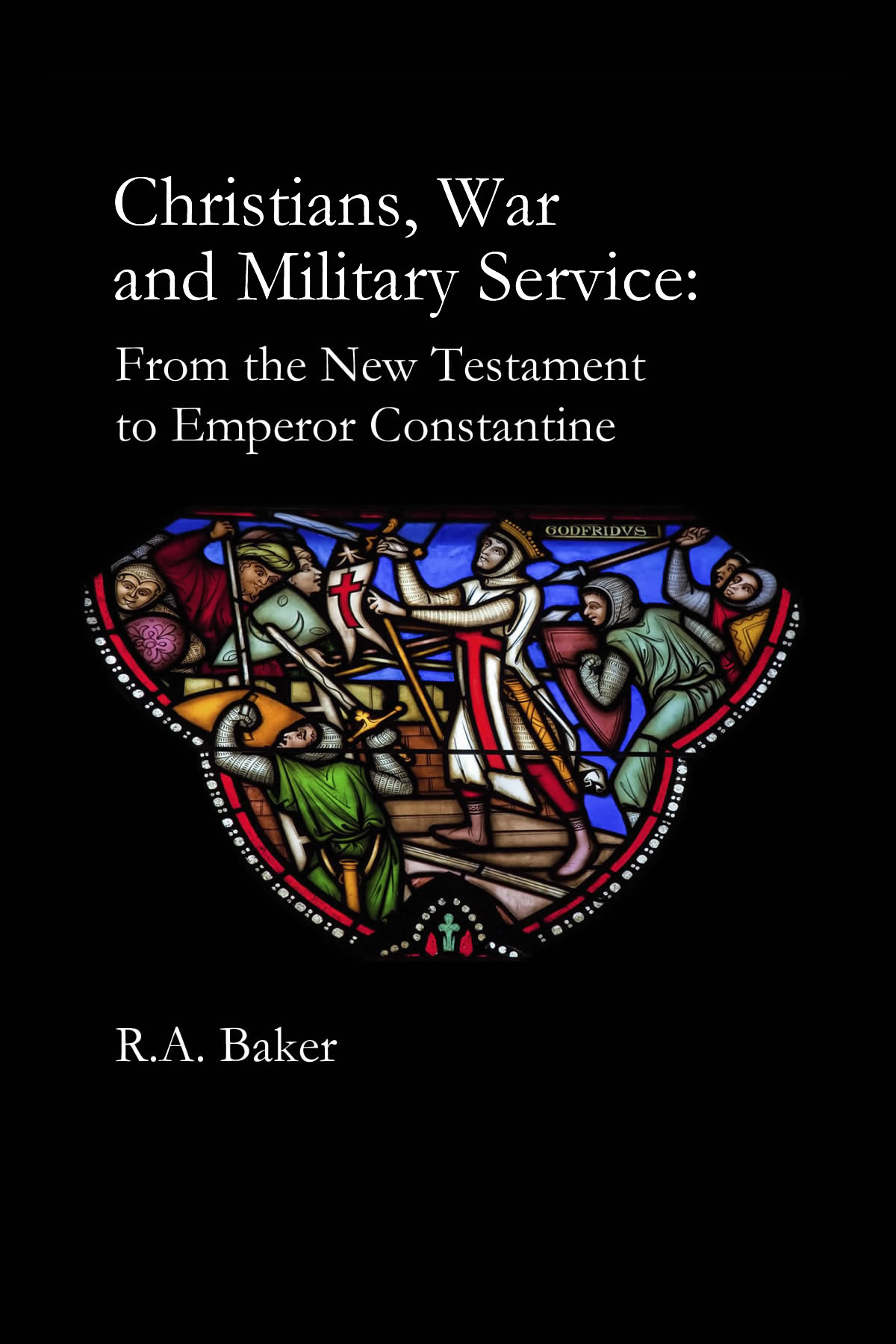 Pacifism, the Military and Christianity
Other links on Pacifism:
Pacifist vs Just War Debate
Pacifism and the New Testament
The Church Fathers and Military Services
CH101 eBook
Christians, War and
Military Service: From the New Testament to Emperor Constantine
My Feedback page on The Early Church Fathers and the Military brought several comments, but the one below sparked some good discussion regarding pacifism and the New Testament.
My Response:
I appreciate your comment and I understand your perspective.
First, I would like to offer a comment on your secondary point:
I would ask you to consider that people will not be judged by whether or not they hear
a particular gospel presentation. I think Paul addresses this in Romans 2.
My Opinion: People will be judged by God's justice based on how they lived according to what they knew. If and when someone is judged by God it will be because they refused to live by what they knew was truth. If you have not read CS Lewis, "The Great Divorce," you should go get it.
It is a profound way of thinking of Hell and final judgment.
If you are correct, then a Christian cannot take part in the prison system because prisoners are killed every day by other inmates. A Christian guard could somehow be cooperating in a death. A Christian would not be able to be involved in a capital trial that could end in the death penalty. A Christian could not be a lawyer or a Judge because he/she might be involved in some way with the death penalty.
A Christian would have to be very careful about being in the medical field. What if their actions (or inactions) helped lead to a death? Now I realize that this is a far cry from killing someone in battle, but the logical threads are there nonetheless and must be explained, or at least contemplated if you take such an absolutist stand.
What if an armed robber breaks into my house? Do I hope and pray that he will not kill me and my children? Do I trust that he will not rape and kill my wife and kids like the guy did to the doctor's family in Connecticut (the Joshua Komisarjevsky trial). If I shoot and kill him to protect my family is that the same as the soldier in the battle?
Just some things to think about.
Comment:
From John, Georgia (somewhat abridged)
I can't say I disagree with your points but I look at verses like “Love your enemy and pray for those who persecute you.” ( Mt 5.44 , Lu 6.27 , Lu 6.3 ) “Do not use force against an evil man.” ( Mt 5.39 ) “Do not resist evil with evil.”... “Forgive and you will be forgiven.” (Lu 6.37 ) “Do not be anxious about your life.”( Lu 12.22 ) “He who lives by the sword will perish by the sword.” ( Mat 26.52 ) “In everything do to others as you would have them do to you.” (Mat 7.12 ) and I wonder WWJD. Can I see Jesus asking His disciples to use force or violence to defend an attack against Him?
In the case of my friend being violently beaten, [a street preacher attacked while preaching - he kept yelling to his friends that they should NOT defend him nor call the Police] we did call "911" but it took a few minutes for the police to show and by the time they showed it was all over and the lies began.
This preacher said he would not stand by to see anyone harm his family. He would try and use a minimum amount of force in that situation....In Atlanta my brother-n-law tackled a homosexual man who tried to attack me at a gay pride event (I questions his wisdom but love his zeal)....In preaching the gospel, I feel a different standard as in your home. Just being in the situation of preaching in a public place and being violently attacked seems to demand pacifism....Another friend of mine was punched in the nose and would not wipe the blood and it had a powerful effect upon the those watching as he preach about the blood of Christ.
I have come to my own personal convictions and hope they please the Lord. I cannot say "THE BIBLE SAYS" as an across the board rule as what all should do in every situation. I have come home many times and prayed to God to have mercy & forgiveness on me because I thought I handled a particular situation wrongly. I do not have the absolute answers to these difficult scenarios but like hearing others opinions as it helps me think.
My Reply
I have some difficulty using the Sermon on the Mount as an absolute rule. An ethical guide, yes. But not a rule. We all agree that Jesus uses hyperbole in this message. We all agree that he is presenting a HIGH road of ethics and spirituality, maybe one that is impossible to attain completely (I would certainly say this, but I know others would disagree). I think he is intending to expose the religion of the Pharisees and present His ideals which were contained not in the rituals or keeping the laws of the OT, but in the new heart of Jeremiah's vision.
I think we also need to keep the historical context in mind when we read "Love your enemy," "Do not use force," and the "die by the sword" comment: in addition to simply preaching the new kingdom of God, Jesus has to keep from being drawn into the desire of the Zealots who want a Messiah to overthrow the Romans. Many of the Jews believed that the only way to shed Roman rule would be by the sword. Even the Essenes thought it would take a military confrontation, though their vision was more of a heavenly army.
So in the first instance, I do think these citations really speak to the issues we typically think about when we discuss pacifism. I think ALMOST ALL Christians would agree that to advance God's kingdom through military force is NOT what God intends.
To use physical force or violence to advance God's kingdom is categorically different to me from defending oneself from violence. I would have to ponder each circumstance on its own merits, but my basic belief is that self-defense is never wrong. This is an understanding that comes from Mosaic law - true self-defense is always acceptable.
For a street preacher to allow himself (or others) to be physically assaulted and beaten without allowing someone to HELP is actually encouraging anarchy. "When the sentence for a crime is not quickly carried out, the hearts of the people are filled with schemes to do wrong." Ecc 8:11. When this preacher allows himself to be beaten and refuses the help of his friends some onlookers with a weak conscience will not be deterred at all from beating someone on the street. If that street preacher had friends nearby with stun guns and zapped an attacker, others would think twice before attacking him. I am not suggesting that this SHOULD be done, but neither would I say that stun gun self-protection is sinful.
I would also suggest if something like that happened the preachers should probably retreat in order to avoid an escalation of violence. I am not advocating the encouragement to use violence - I am mainly in strong disagreement with the absolutist view of pacifism using the NT texts as an authority.
Turn the other cheek and resist not an evil man. How do the words of Christ compare to "I will do harm to those that try to harm me or my family"...or "I will get you before you get me." Christ spoke negatively about "eye for an eye."
Thank you for your comment.
Does turn the other cheek mean that we sit back and allow a lawless man to brutalize our children, our wife, and maybe kill us? How far can we go to protect our family?
Do we bother to lock the doors? or the cars?
When we purchase a house, do we purpose to live in a safe environment? or do we blindly live in the inner-city or drug cartel Mexico?
Please do not preach at me. Answer these questions so I can know how you are thinking through these issues. Where did you get the "I will get you" quote? This is not at all what I am talking about unless you are talking about a lawless person who has invaded my home, knows that I will defend myself, and fails to vacate my property. In THAT circumstance, then yes, I will get him before he gets me and my children.
I look forward to hearing more of your thoughts.
What happens to me is for my benefit.
It is either for my natural benefit or spiritual benefit. Its good for the body or the soul or both but never neither. ELSEWISE God is either powerless or unloving or both.
This logic along with the sermon on the mount, as well as the Royal commandment/golden rule, is how I take Christ at his word for how he would have me act in all situations.
If we are powerless to flee or somehow otherwise evade the evil man without committing evil in the process then Yes, if we are to take Christ at his word then turn the other cheek means just that in any situation no matter how unpleasant.
What about martyrdom? How many Christians could have avoided gruesome deaths by merely denying Christ. Is there a difference between denying Christ and ignoring his teachings? And in the grand scheme of things what difference would it make to my wife if she were brutally raped and murdered IF she ends up spending the rest of eternity in paradise/ heaven?
As far as retaliation: No one can make me do anything. I choose to obey or disobey. I choose to bless the man that rapes my wife or I choose to take an eye for an eye. What teaching of Christ teaches that the end justifies the means? It is obviously good for my wife not to be raped, BUT how can I commit evil to obtain that end. How can I make an account to our Lord? Evil is evil absolutely!
What do you think Christ meant when he preached the sermon on the mount?
"Do we bother to lock the doors? or the cars?"
It depends on why. We probably should only lock our cars or houses so far as not to cause a stumbling block for others; we should not tempt one to steal etc. Furthermore we are cautioned: if we worry about our treasures being stolen then we might have stored up the wrong kind of treasures.
If God controls everything, then how do you know that He did not induce Hitler to murder His people? To say that we must do nothing in the face of evil saying that we must allow things to play out, assuming that God is in control is to deny our free will.
If we are not to defend ourselves in the face of evil, depending ONLY on God's sovereignty would then demand that we never use medical science for our health: no high blood pressure medicine, no insulin....
Surely you cannot use martyrdom as an analogy to defending one's family?
Surely you are not making denying Christ the same as defending one's family?
Interesting you use this example since many did in fact deny Christ during persecution and sought forgiveness after the persecution passed. Even Tertullian says these can find mercy - Peter denied Christ three times and found mercy.
Pacifism, the Military and ChristianityOther links on Pacifism:
Pacifist vs Just War Debate
Pacifism and the New Testament
The Church Fathers and Military Services
CH101 eBook
Christians, War and
Military Service: From the New Testament to Emperor Constantine
The Sermon on the Mount
A picture of the absolute mercy and justice of God.
We cannot live it. We should strive for it, but it is beyond us.
We cannot measure up to His holiness, thus His mercy covers us.
The fact is that I will probably never have anyone break into my house with evil intention.
I will probably never have to point my gun at a person.
I will probably never have to shoot and kill anyone.
I am trusting that God will protect me from all of this.
You want me to abide by the Sermon on the Mount?
I am guilty.
You want to judge me for my belief in self protection and my rejection of pacifism?
I am not worried about being judged for my views on self-defense. I have failed to live out The Sermon on the Mount many times. I cannot tell you how many times I have lusted in my heart. Thus, according to the measure you have measured for me I am a multiple adulterer. How many times? Probably more than 70 times 7.
I am a sinner.
I have no hope without His mercy.
I do not sin without concern or remorse. But I do sin.
Happy to debate the topic. I just do not want to do it knowing that I am being judged behind the scenes.
I confess. I am guilty.
Now if you want to continue the discussion I welcome it.
Do I say I am perfect? I am not! I have violated every tenet of the sermon more than even just one time.
I do know I am capable of the sermon on the mount. Or rather, through Christ I am capable of striving for perfection. I agree. The sermon is the definition of perfection. Perfect is absolute righteousness. Am i perfect? Again no!
Does this mean give up? (By the grace of God can I at least be some degree of righteous?
We are not yet capable of perfection. So there must be something other than perfection that is pleasing to God. No! there is nothing pleasing to God other than perfection. Perfection is absolute righteousness. We can not please God by our works. We are only justified by faith and faith without works is death.
Do I want to be judged by the sermon? I don't see how I have a choice! Christ said if I don't I am like the fool. So I argue that it is not what I want, rather it is what Christ wants.
That is why I plead with you: Let us change our speech from kill the intruder to try, try, try to turn the other cheek. If we might fail tomorrow let us ask for strength today. To God be the Glory!
Ok. Let me make it clear:
I certainly do NOT want to kill an intruder. I would first chamber a round. An intruder hearing that sound knows that I am armed (first warning). I would probably next yell out that I am armed and will shoot to kill (second warning).
At this point I have given the intruder the opportunity to flee. Now, if it comes down to shooting and the intruder is also armed (which means he/she is lawless), I will shoot to kill. This is my conviction that self-defense is sanctioned. I understand that a pacifist disagrees with me. That does not cause me to lose sleep.
If (God forbid) I ever have to taken this action, I am sure I will lose sleep. I will pray. I will ask for God's forgiveness. I am not trying to be a cowboy or a tough guy...I just believe that self-defense is sanctioned.
Notice that I do not say "Killing is right." But sometimes we are in positions where we must act and sometimes that action is not "right," or "good."
Jesus told Peter to put his sword away, but why was Peter carrying a sword anyway? Jesus is never on record telling Peter NOT to carry a sword. The sword was not for slicing figs, it was for protection.
In Luke 9 we have Jesus sending the disciples to preach. He tells them, "Take nothing for the journey — no staff, no bag, no bread, no money, no extra shirt." We do not take this to mean that any preacher should travel like this do we? If Jesus had added, "take no sword," people who hold to a pacifist view would cite this text as well.
In addition, we have the text in Luke 22:
He said to them, "But now if you have a purse, take it, and also a bag; and if you don't have a sword, sell your cloak and buy one...The disciples said, "See, Lord, here are two swords."
"That's enough!" he replied.
The point here is that we cannot take the words of Jesus literally at each and every point. We must have some kind of methodology for reading/understanding His words.
Many have written me to stress how we MUST live out the commands of Jesus. Ok.
How about Matt 6:19 "Do not store up for yourselves treasures on earth, where moths and vermin destroy, and where thieves break in and steal."
To obey this literally means that one should not have a Savings account, a 401k or an IRA, no pension, no investments.
"Go, sell all of your possessions, give it to the poor, then come follow me."
Is this a commandment to be taken literally?
You obviously do not believe this or you would be living in a cave or under an overpass.
Saint Anthony (and many others) took it literally, but MUST we do this?
"Anyone who will be my disciple must hate his father and his mother."
Literally? No, we explain what he means.
"If your hand causes you to sin, cut it off..." Really?
So what does it mean when Jesus says "Be perfect, as your Father in heaven is perfect?"
You say that the end of the Sermon (the house on the rock or sand) indicates that we are to live according to the Sermon, so how you define "perfect" is fairly important.
Contradiction, tension, paradox...none of these bother my faith too much. All of these happen when the eternal perfect one is dealing with finite flawed people.

Questions, Comments or Criticisms:
You can send an email to directly to me Al Baker, CH101.
CH101 retains the right to edit and post comments/questions unless you specifically ask that your comments NOT be posted. Comments that are personal or private are never posted...only questions about Church History, the Bible, etc.
Questions/Answers
-
was athanasius black
-
tertullian/paul/marcion
-
worship on sunday
-
origen and universalism
-
water baptism
-
wine in ancient world
-
fathers on NT Revelation
-
fathers on holiness
-
fathers on the military
-
apostolic succession
-
palestine or israel?
-
candles in church
-
pagan influences
-
constantine-Sun worship
-
constantine vs donatists
Book Reviews
- church traditions
- book reviews
- Buzzard - the Trinity
- David Bercot books
Biblical Issues
-
what is false doctrine?
-
pacifism and the NT
-
who wrote NT Hebrews
- the trinity
- the apocrypha
- saul the persecutor
- NT, faith, resurrection
- NT and tithing
- Is the NT inspired?
- wine in the bible
Water Baptism in the Early Fathers
Baptism in the Early Creeds - Second Repentance
Evidence on Water Baptism in the New Testament
Water Baptism is NOT Required for Salvation
You Cannot Take Every Word of Jesus Literally
- christian tolerance
- faith and certainty
- PragerU - Canada
- end of the spear

ist Century Church History
The conversion of the apostle Paul
Early Church History of Galatians
James Just brother of Jesus in the Bible
1st Century Christian Church Struggles
Christian History - conversion Apostle Paul
Palestine - Philo, Josephus, Strabo, Aristotle
Apollos NT Hebrews in Ancient Rome
Apollos NT Hebrews in the Bible
Wine in Bible Alcoholic?
James the Just and Jesus in the Bible
Hellenized Jews Gentile Christians
Hellenized Jews New Testament
Jews and the conversion of the apostle Paul
Conflict in the Early Christian Church
Palestine vs Israel Zola Levitt Dr. McCall
Palestine in the Bible and the Ancient World
Apollos NT Hebrews in the Bible
Apollos NT Hebrews - Ancient Roman World
Palestine Israel in Ancient Greece Rome
Alcoholic Wine - New Testament
James the Just Paul and Jesus in the NT
How the New Testament was formed
How the NT Canon was formed or canonized
Questions about Wine in the Ancient World
Wine Alcohol in the Bible - New Testament
Early Church Catechesis - Catechetical Training
Questions regarding Christian Issues
Palestine - Israel Map Ancient World
Apollos Alexandria Hebrews in the Bible
Apollos Paul Corinthians - Bible
James the Just the brother of Jesus
1st Century Persecution of Christians
Gnosticism in the 1st Century Early Church
Early Church History of Galations
Early Christianity War and Conflict
Early Christianity Constantine and War
Important Issues in Early Christianity
Palestine Israel in Greek Roman World
Apollos Alexandria Hebrews - Bible
Apollos Paul Corinthians NT
go