CH101 Book Reviews

I like to write book reviews and am happy to take requests if there is a book you would like me to make comment on.

The Christian’s Secret to a Happy Life, by Hannah Whitall Smith
Will the Real Heretics Please Stand Up, by David Bercot
Peter, Paul & Mary, by Bart Ehrman
Lost Christianities, by Bart Ehrman
The Doctrine of the Trinity, by Anthony Buzzard


The Christian’s Secret to a Happy Life, by Hannah Whitall Smith

My review is in response to a very “sad” review written from an already established position. The reviewer (I think Tim Challies) gives us what he thinks is the thrust of the book, “What must the Christian DO in his quest for VICTORY?,” then offers his simplistic review of Hannah Smith’s response, “NOTHING.” Challies then sums up Smith’s work with his critique of “the man-centered and subjective age in which we live,” and puts Smith in this category. This is an amazingly simplistic (and ignorant) summation by an educated person - this is why I think it betrays “an already established position.”

I HIGHLY recommend this book - it is a Christian Classic and will continue to be read and to help believers for years to come. Buy this Hannah Smith book on Amazon.com

Hannah Smith lived in the latter half of the 19th century - the terms “happy” and “gay” had different meanings in common use than what we have today. A better title for this book would be “The Christian’s Secret to a Joyful Life,” but we cannot retitle the work.

Smith is writing to refute the basic practical theology of her strict Quaker background which apparently leaned heavily on the force of a person’s determined will and discipline to gain freedom from sin. Many of us have seen how this emphasis, while possibly effective in the life of one generation, can lead to dead works and dry religion in the following generations that lack the intense affections of the initial leaders and have only been given the “right doctrine” to live by.

Let’s allow Hannah Smith to speak for herself:

The most difficult thing we have to manage is self….In laying off your burdens, therefore, the first one you must get rid of is yourself. You must hand yourself and all your inward experiences, your temptations, your temperament…all over into the care and keeping of your God, and leave them there. He made you, and therefore He understands you and knows how to manage you, and you must trust Him to do it. Say to Him, “Here, Lord, I abandon myself to thee. I have tried in every way I could think of to manage myself, and to make myself what I know I ought to be, but have always failed. Now I give it up to thee. Do thou take entire possession of me….And here you must rest, trusting yourself thus to Him continually and absolutely….

Perfect obedience would be perfect happiness….
Consecration is the first thing….In order for a lump of clay to be made into a beautiful vessel, it must be entirely abandoned to the potter, and must lie passive in his hands. And in order for a soul to be made into a vessel unto God’s honor, “sanctified and meet for the Master’s use, and prepared unto every good work,” it must be entirely abandoned to Him, and must lie passive in His hands….

Oh, be generous in your self-surrender! Meet His measureless devotion for you, with a measureless devotion to Him. Be glad and eager to throw yourself headlong into His dear arms, and to hand over the reins of government to Him. Whatever there is of you, let Him have it all. Give up forever everything that is separate from Him. Consent to resign from this time forward all liberty of choice…
(I cannot find my copy to give a reference - I have used the online version)

This is far from doing NOTHING. Smith’s focus is on the most difficult aspect of living for God - the abandonment of YOUR will. She maintains that IF you can truly abandon yourself (I do not think this can be done 100% of the time anyway) God will do His work in you. In the past, some 20 years ago when I first read this book, I wondered if Watchman Nee had read Hannah Smith. In his little powerful book, “Sit, Walk, Stand” he says this,

“If at the outset we try to do anything, we get nothing…For Christianity begins not with a big DO, but with a big DONE.” p.14 (Tyndale, 1977)

Maybe Challies believes that Nee also distorted scripture here (I should confess that I am not a fan of everything Nee writes).

Again, Challies: “God calls Christians, not to happiness, but to holiness.” Smith’s comments on “perfect obedience would be perfect happiness” directly address this accusation. Did Challies really even read Smith’s book? It is difficult for me to think so.
“The Christian’s Secret to a Happy Life” is far from the “self-help psychobabel” label Challies gives to it.

It is true that Hannah Smith did not have a “happy” life. She had some marital issues and an unfaithful husband; she seems to have suffered some depression; and her theology was not always orthodox - she apparently struggled with the concept of eternal punishment (like Origen!). Nonetheless, this book by Hannah Smith has remained a Christian classic for a reason - it is challenging and good.

And by the way, Hannah Smith did die in great misery - she suffered from arthritis during the final years of her life.

R.A. Baker
Ph.D. Ecclesiastical History

Comment Here:

You can submit a comment or ask a question using this simple form, or use our Contact/Feedback Form.
CH101 retains the right to edit and post comments/questions.
E-mail Address:
Please add comments below:
If you include links do not include "http:"


Will the Real Heretics Please Stand Up: A New Look at Today’s Evangelical Church in the Light of Early Christianity, by David Bercot

I struggle with this book by David Bercot - as a critique of the evangelical church in America I would give this book 4 stars, but as an historical glance at the primitive church it would only receive 2 stars. Yes, Bercot allows the early fathers to speak for themselves, but he fails to give the reader any historical context. He also only allows them to say the things he wants them to say - in other words, there are many other things these early fathers said that are not included because they either contradict his thesis or are not as flattering. I could lift numerous passages from the Gospel of Truth (we think Valentius was the author) that would sound great; I could also find numerous passages from almost any of the fathers Bercot used that would be far less flattering. Historical context is everything.

After my critique of a similar work someone sarcastically wrote to me, “…You think nobody can possibly read the early fathers and understand them. I guess we all need a Ph.D. to be able to understand anything.” I certainly do NOT want to give anyone the idea that only pinheaded Ph.D.s can read/understand the early fathers, but it is not an easy task. Most of us have some idea of what the apostle Paul means when he tells women not to cut their hair, and tells the men not to wear their hair long. While commentaries on 1 Corinthians are fairly easy to find, very few people have scholarly works sitting on the shelf to help them understand what Tertullian means when he describes how to deal with “sinners” in the church,

…when you lead the penitent adulterer into church to beg the intercession of the brethren, place him on his knees in their midst, covered with sackcloth and ashes, in an attitude of humiliation and fear, in the presence of the widows, in the presence of the priests, moving all to tears, kissing the footprints of all, embracing the knees of all. On Purity 13

Because I do not want to come across as demeaning, I want to be careful not to critique each and every issue I disagree with in this book. I will mention the places where I agree with Bercot, and I will try to illustrate why I disagree on some issues. My overview of Bercot is that he takes a very simplistic reading of these early writers. My primary methodology will be to give examples from these writers that either contradicts, or shows a different angle, from what Bercot reports.

Bercot’s introduction is the martyrdom of Polycarp - it is almost impossible to criticize the use of this inspiring passage. In chapter 2, however, Bercot reveals what to me is a telling predilection when he says,

“…these men were not church fathers! Most of them were fairly ordinary, hard-working Christian leaders with above-average education. They would have been highly indignant at being called ‘church fathers.’ The only ‘church fathers’ they recognized were the apostles.”

This statement is silly. I guess Bercot is anticipating, and playing to, an anti-Catholic bias in his audience. Maybe for Bercot and his audience the term “church fathers” is a four-letter word. The second century fathers certainly would not have considered themselves to be “fathers” - they only became fathers in the next few centuries! As a good friend suggested, these men could not have been “fairly ordinary” in the ancient world if they had an “above-average education.” The overwhelming majority of the population was illiterate. Indeed, most of these early church fathers were far from ordinary men - they had great minds (Justin, Tertullian, Clement and Origen); they were obviously not ordinary since they were leaders in the church; and they ARE now known as “fathers” precisely because they were extraordinary.

In Chapter 4 Bercot begins his direct critique on 20th century North American evangelicalism (remember this book was written in 1989). I basically agree with many of his comments regarding divorce and abortion - if he were writing now he might criticize the basic evangelical position on homosexuality. I have my own concerns regarding feminism and the effect this issue has had on American Christian men, but Bercot’s comments on women in chapter 4 reveal his lack of understanding of both the biblical text and the ancient world.

I realize this borders on being an academic pinhead for some people, but Gordon Fee released his commentary on 1 Corinthians in 1987 where he showed, quite convincingly, that the “women shall keep silent” passage in 1 Cor 14 almost certainly was not in the original Pauline letter. Because of this it is problematic to use the complimentary text from 1 Timothy since most non-conversative scholars doubt Pauline authorship of that NT letter (the fact that I DO hold to Paul’s authorship does not change my mind that this is NOT a good argument from the biblical text). Bercot’s comments regarding women in the ancient world are stunning - is he really saying that women were seen as equals in the Greco-Roman world?

“But Roman women were hardly known for their submissive character. As one Roman commented, ‘We rule the world, but our women rule us.’” When I read this I found myself thinking, “Who said that?” I followed the footnote and found that Bercot is citing a secondary work…and only gives us the page number! Bart Winer said this on page 176!? This is Bercot’s ONLY scholarly notation for making such a claim.

[ - comments added Dec 13, 2009 and updated Oct 11, 2010 - ]
The New York Times calls Winer's book, Life in the Ancient World "a children's book." Bercot should at least tell the reader who in the Roman world said this. You can see this "citation" in Winer's book using Google Books. Winer uses quotation marks, yet does not tell the reader who said this. We must remember, it is a children's book. Winer did not properly cite his work, and Bercot should not use this as a reference. Bercot is using a children's book as a reference!

He says that the early church went against the ancient culture by denying women any role in leadership. I would say that the apostle Paul went against Greek, Roman, and Hebrew culture by OPENING the doors of leadership to women. It was the early church that went against the Pauline tradition left to us in the New Testament.

Chapters 5 and 6 are basically just “good preaching.”

“This was one of the secrets of the early Christians. They were able to reject the ungodly attitudes, practices, and entertainment of their culture…” p.42

It becomes clear reading these chapters that Bercot is Wesleyan, or anti-Reformed, in his theology. Bercot wants to challenge evangelicals to shun what Bonhoeffer coined “cheap grace.” I agree with this challenge, but do not like using these early writers for support. Each of these early church fathers had their own challenges: Clement of Alexandria did cite the New Testament quite a lot, but he also cited, and was heavily influenced by, Plato as well. Although he attacked the Gnostics, he embraced some aspects of Gnosticism. Tertullian stays away from Greek philosophy, but he holds a very strict view on repentance and restoration - he actually joins the Montanists (the group Bercot calls heretical on page 37). Yes, Tertullian joined the sect that had women serving in leadership. He eventually left the Montanists because they were also too “liberal,” and started his own group.

At the end of Chapter 6 (pp.66-67) Bercot tells us that the Gnostics preached salvation by grace alone. I have read and studied 15 or more Gnostic texts, and I have read numerous scholars whose expertise is Gnosticism - I have never heard Gnostics referred to in these terms. Gnostics believed that salvation was obtained through learning gnosis, knowledge. This knowledge helped them traverse through the heavenly levels by equipping them with secret passwords. Salvation through grace alone? I have never seen or heard anything in Gnostic texts that made me think of salvation by grace alone.

Tertullian is one of the strictest second century fathers yet he says this regarding the struggle against sin,

“It is a fact that there are some sins which beset us every day and to which we all are tempted. For who will not, as it may chance, fall into unrighteous anger and continue this even beyond sundown, or even strike another or, out of easy habit, curse another, or swear rashly, or violate his pledged faith, or tell a lie through shame or the compulsion of circumstances? In the management of affairs, in the performance of duties, in commercial transactions, while eating, looking, listening — how often we are tempted! So much so that if there were no pardon in such cases, no one would be saved. For these sins, then, pardon is granted through Christ who intercedes with the Father.” On Purity 19

In Chapter 7 Bercot attacks the doctrine of Predestination. One of his targets seems to be Martin Luther. I have never read/heard Luther attacked for predestination and I have no idea if he held to this position. I agree with Bercot that the second century fathers did not promote predestination, but a significant part of his argument comes from a lengthy passage in Origen’s On First Principles. In this same document Origen presents his speculative theory of universalism. This is one of several issues that led to the “Origenist controversy” which caused problems for several centuries. For Bercot to use anything from this document seems ironic at best.

Chapter 8 is on baptism. Bercot basically maintains that evangelicals have marginalized water baptism. I agree with him for the most part.

Chapter 9 is on prosperity and the “name it, claim it” doctrine that was far more popular in the 80’s. Again, I basically agree with Bercot on his criticism, I just would not use these early Christian fathers as evidence. As I mentioned earlier, these men were NOT ordinary. Few believers had wealth in the second century - most were of the lower class. But there were wealthy believers who did not give away all of their possessions and were not urged to do so. One interesting point is that Bercot uses a quote from Clement of Alexandria’s “Who is the Rich Man Being Saved.” It might be interesting to hear a few of the points Clement gives in that treatise.

“Who is the Rich Man” is basically Clement’s commentary on the story of the Rich Young Ruler as told in Mark’s gospel. It is important to remember that giving away one’s possessions to live in poverty (or at least to live a very simple lifestyle) was not something new in the day of Clement, or during the time of Jesus for that matter. Neo-Pythagoreans, most notably Apollonius of Tyana, promoted a rigorous asceticism which included a rejection of material possessions. Clement does his best in all his writings to make Christian faith THE best philosophical system, so he tends to take some positions that appear to go against typical orthodox thought if it will help him accomplish his desired goal. He also has in mind the Montanist movement which also advocated the rejection of material worldly goods in favor of the heavenly kingdom that was to be quite immanent.

In chapter 13 Clement argues that the Lord enjoins us to “give drink to the thirsty, bread to the hungry, to take the houseless in, and clothe the naked,” but Clement goes on to say that this is impossible to do IF you have given ALL of your material possessions away:

Riches, then, which benefit also our neighbours, are not to be thrown away. For they are possessions, inasmuch as they are possessed, and goods, inasmuch as they are useful and provided by God for the use of men; and they lie to our hand, and are put under our power, as material and instruments which are for good use to those who know the instrument. If you use it skilfully, it is skilful; if you are deficient in skill, it is affected by your want of skill, being itself destitute of blame. Such an instrument is wealth. -  Rich Man 14

So that (the expression) rich men that shall with difficulty enter into the kingdom, is to be apprehended in a scholarly way, not awkwardly, or rustically, or carnally. -  Rich Man 18

The point is that Clement of Alexandria is presenting the case that it is not always good to give away all of your riches - there is a place in the faith for people with great wealth. This, of course, is why I find it ironic for Bercot to use this document without giving the reader any historical context.

In Chapter 10 Bercot focuses on the proper Christian attitude towards war.
I want to give an overview of his mistake.

Bercot does admit that “the early church made no law that Christians could not serve in the army…Neither Jesus nor the apostles ever strictly forbade Christians to serve in the military,” but he goes on to say that the empire was experiencing peace during the second century and soldiers were more like police officers. (p.97) This is an absurd argument.

Here is the historical context: every 20 to 40 years Christianity would get slapped around. Pastors and bishops would be arrested, thrown in jail, and some would be executed. Laypeople would be tortured and forced to sprinkle salt on the altar to the empire at the risk of being thrown to wild animals in an amphitheatre. Roman soldiers were known for their cruelty in battle, but they were also known for their cruelty towards Christians during these times of persecution. Even during times of peace Roman soldiers had license to make harsh demands on average citizens.

With this context in mind, why would Christians be encouraged to serve in the military? The citations used by Bercot are each commenting on military service for Rome, not military service or warfare in general. I know a man who was a pastor in Cuba when Fidel Castro led the Communist takeover. He fled with his family, but many of his friends were ripped from their beds in the middle of the night, beaten, imprisoned, and some killed. Would it surprise anyone if Christians in Communist Cuba were discouraged from enlisting in the military after the takeover? You cannot compare military service in modern-day USA with the Roman empire. You might disagree with Korea, Vietnam, and Iraq; you might think the USA is emperialistic, but you simply cannot objectively compare soldiers in the USA to those in the Roman empire in this way.

[This section edited Dec 13, 2009]
Some of the early fathers discouraged military service (mainly Tertullian), but they also did not encourage believers to be involved in politics or acting. Overall, they speak negatively about politics. Does this mean that we should discourage believers from serving in the political arena as well? The problem with this is that the New Testament does not have this prohibition against military service or politics. As much as I respect the early fathers, the NT is our primary authority when it comes to the teaching of the apostles.

In fact, we are given a fairly positive view of military service in the NT.
- Jesus heals the daughter of the Roman centurion with no indication of displeasure for his military service - Luke 7:1-10
- Peter shares the gospel with Cornelius - Acts 10
- Paul refers to believers in the household of Caesar - Philippians 4:22
- Paul uses soldiers as a positive analogy - 2 Timothy 2:2-3; 1 Corinthians 9:7; Philippians 2:25; 2 Timothy 2:3-4.

But I want to further address Bercot's mistake. As with many other issues, Bercot only presents one side of the data. In his presentation he cites Tertullian's treatise The Crown where he tells the story of a Christian soldier who refuses to wear the appropriate headress laurel with his fellow soldiers. He is mocked, stripped of his commission, and imprisoned to await death. But this treatise itself shows that Christians were, in fact, serving in the military.

Eusebius tells us that Christians were serving in governmental positions and in the army long before Diocletian. (Church History 8.1) He mentions that some Christians were allowed to refrain from sacrifice (8.3) apparently being shown preferential protective treatment. Lactantius tells us that Christian attendants to Diocletian made the sign of the cross while fortune tellers were trying to divine the future for the emperor, thus causing the soothsayers difficulty. Diocletian demanded that these Christians be whipped. He also sent orders to his commanders that all Christians serving in the military be made to offer sacrifices or be dismissed from service. (Of The Manner in Which the Persecutors Died 10.6)

These examples show that although Tertullian was against military service, the early church did not have a concensus view. This is typical of early Christianity - there is diversity of opinion and practice on many, many issues. Bercot fails to appreciate the evidence for this in the data or just fails to present this evidence to the reader.

Chapter 11 is titled “Who Better Understands the Apostles?”
Bercot basically argues that these second century fathers are better trusted than we are to interpret the NT writings. He points to the early testimony of those like Clement of Rome and Papias who had opportunity to hear some the apostles. Bercot then mentions oral tradition, but tries to say that there was no oral tradition beyond what we have in the NT. This position is a very difficult one to defend - there are several documents in early Christianity that were not accepted into the NT canon, each containing snippets of what were most likely early traditions. Clement of Alexandria (Strom I.1.11-13) and Origen (Celsum VI.6) both affirmed oral traditions that were not contained in the written texts.

It is also amazing that Bercot cites Papias, then goes on to marginalize oral tradition - this is exactly what we have in Papias - early oral traditions about the apostles. Papias states that he is not so fond of "things out of books," but that he preferred "the utterances of a voice which liveth..." (Eusebius CH 3.39,1-4) Funny, Papias marginalizes written tradition in his written document, The Sayings of the Lord Explained.

The remainder of Bercot's book is basically an attack on Constantine, Augustine, the Nicean Council, and everything else Catholic. Bercot argues that the second century church was far more dedicated, yet the writers he uses complain in many places about the worldliness of the church in their day. Were there growing problems in the church after the second century? Yes, as the church grew numerically and into new cultures, and as church leadership became more bloated problems increased. Theological issues and debates developed due to heretical movements - a growing theology led to theological disputes.

My overall critique of Bercot’s book is this: he wants to point to the second century church as some kind of ideal that we should attempt to emulate. While I think there are positives to be seen in every era of church history, I do not think the second century, or any other era, should be pointed to as the “ideal.” In addition to the various specific critiques I have offered, the second century writers also held numerous doctrinal positions that Bercot would NOT want us to embrace: purgatory (Origen), mortal and venal sins (Tertullian), forgiveness of sins rests with the bishop (Ignatius, Cyprian), and many others. It appears to me that Bercot takes the Early Church Fathers on CD and does a “Ctrl + F” to “Find” passages that speak to a particular issue. If he likes the passage, he uses it. If the passage does not support his thesis, he ignores it.

The writings of the early church fathers must be used with care. Historical context is critical.


Comment Here:

You can submit a comment or ask a question using this simple form, or use our Contact/Feedback Form.
CH101 retains the right to edit and post comments/questions.
E-mail Address:
Please add comments below:
If you include links do not include "http:"


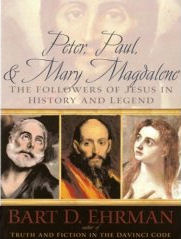
Peter, Paul, & Mary Magdalene: The Followers of Jesus in History and Legend, by Bart Ehrman

(This review was posted on Amazon.com - December 26, 2007)His use of the legendary counter-cultural rock group aside, there are very few new ideas in this book for those who have already read other Bart Ehrman books. He opens this work taking familiar passages from the New Testament, standing them next to passages from extra-biblical documents and asking, “Does the historian accept what is found in the Scripture as being historically accurate and what is found outside of it as inaccurate? On what grounds?” (Introduction, p.xiv) He rightly reminds the reader that every writer, both ancient and modern, has an agenda that must be understood if you are to correctly understand the document, “This is especially true of the early Christian Gospels.” (p.10)

Let me state from the outset, I like Bart Ehrman. He is an accomplished scholar; he is a good writer (I enjoy reading his work and typically read every word); and he is a charismatic lecturer (I have sat in on one of his lectures). I agree with many of Ehrman’s thoughts and I especially applaud the fact that he is forcing us to think more critically about the New Testament.
*sigh* Glad I got that out of the way.

Ehrman challenges you to read the NT gospels “horizontally,” meaning to compare stories from Mark’s gospel to the same story in Matthew or Luke. His purpose is to make you see the various differences and to question which version is trustworthy. He cites a few examples to get the discussion rolling, something he does in his other books, but his objective is not just to “help” you understand better. I would recommend that a reader have some other materials in front of him when reading Ehrman, thus reading him more horizontally. He has a tendency to present data with only his desired emphasis. Yes, Bart Ehrman has an agenda.

He begins with Peter. The discussion on Peter is not as potent as that on Paul and Mary Magdalene, but he does bring out the various extra-biblical documents regarding Peter which is good for anyone interested in this subject matter. Ehrman always does a good job of introducing extra-biblical works and these are the texts he uses in his study of Peter: the Gospel of Peter, the Acts of Peter, the Apocalypse of Peter, the Letter of Peter to Philip, and the Pseudo-Clementine writings. He gives a good overview of why scholars have doubted the Petrine authorship of the NT documents 1 and 2 Peter. He also does a nice job of illustrating from the early church writings why Peter should not be called the first pope, or even the first bishop of Rome. There is not much else in the section on Peter that demands comment. It is here, however, that I must offer my first scholarly critique - Ehrman consistently points to his other works in footnotes without any explanation. I realize these works are meant for a popular audience and not to be academic writings, but he could do a better job here. For example, Ehrman makes it clear that he believes the sermons of Peter contained in NT Acts are basically nothing more than the author of Acts putting forth his own views in the mouth of Peter. (pp.66-67) This is a text-critical statement, highly relevant in the overall thesis of this book. Yet rather than give the reader some explanation, some supporting data for this extremely important point, Ehrman points you to another of his books on the New Testament in the first footnote.

[If you follow that footnote (I do not yet own that particular Ehrman text) you will likely find that he is referring to a famous passage of the fourth century Greek historian, Thucydides, in his “History of the Peloponnesian War,” where he states that he will do his best in the lengthy speeches he records to give the reader the gist of what was said, but that he obviously cannot remember every detail word for word. Most biblical scholars believe that the author of NT Acts does this in the sermons recorded. Fine. But if Luke is the author he would not have been present for Peter’s early sermons. It would do the reader good to know that the Greek in the early portions of NT Acts, especially the sermons, is quite different from the Greek in the latter part of Acts where the author is supposedly giving an eye witness account. The early sermons contain Aramaisms, phrases in Greek that are obviously translations of Aramaic. Luke’s presentation in the early chapters of Acts most likely comes from early Aramaic sources. Ehrman knows this, or least is familiar with the theory, but has decided not to acknowledge it. As he argues, Peter is supposedly illiterate and it is likely that he only spoke Aramaic - any writing attributed to Peter (all we have is in Greek) is likely to have been written by someone else, maybe Peter’s personal scribe. Ehrman gives a good account of this in chapter one, then does an excellent job in chapter six, showing that it is highly unlikely for Peter to have written any document with his own hand. I laughed out loud in my study while reading his humorous sarcasm on page 76 - good stuff.]

The section on Paul opens in typical Ehrman style, showing how the three accounts of Paul’s conversion in NT Acts have differences. Similar to the empty tomb accounts there are differences, yet the basic thrust of the story is the same: Paul is on the road and has a phenomenal (supernatural) encounter with the risen Jesus, and somehow this is witnessed by his traveling companions. Ehrman points out several items to illustrate that “Luke doesn’t have the details right.” (p.97) Ehrman cites examples that are disputed by other scholars, but he fails to mention this even in a footnote.

On page 98 he points to the sermon recorded in Acts 17 - Paul is speaking to philosophers and says that God has overlooked their ignorance. Ehrman says that Paul would have never said this, pointing to Romans 1: “Would he preach the opposite of what he believed?” Ehrman knows that in Romans 1 Paul is referring to those who “oppose” or “suppress” the truth and in Romans 2 Paul sounds very much like the “Lukan” message in Acts 17. He knows this - he just ignores it.

Another example is his treatment of the death of Jesus (pp.143-144). According to Ehrman, Luke portrays Jesus as wrongly put to death, a miscarriage of justice that leads men to feel guilty, which should then lead them to repentance and forgiveness. Paul, on the other hand, views the death of Jesus as necessary, as an atonement. While I basically agree with this argument, Paul makes statements very similar to those made in the Acts sermons about the death of Jesus (1 Thess. 2:14; 1 Cor. 2:8). My point here is that Ehrman finds problems where there might NOT be any problem.

Having pointed out a few places of disagreement, let me say that Ehrman’s discussion on Paul is very good. There are many places where he sounds much like N.T. Wright, but many of these ideas are not new. He never references Wright, but then again, I have never seen Wright reference Ehrman (I have not read more than a couple works of either author).

The section on Mary Magdalene, in my opinion, is the best part of this book. Ehrman shines brightest not when offering his take on New Testament passages, but when he discusses Gnostic writings. He reminds (or informs) the reader that “not much is said” about Mary in the earliest source documents. (pp.185-187) Mary Magdalene appears more frequently, and with more fantastic flare, as we move further away from the first century - Ehrman’s presentation of this is excellent. (pp.248-249) What Ehrman succeeds in doing with this examination of the various Gnostic writings, contrasted with the NT documents, is to illustrate the struggle the early church had with the questions of gender, sexual relationships, and leadership.

Indeed, the early church leaders struggled with many issues as this new understanding of spirituality challenged old ideas of race, class, gender, and nationality. How difficult it must have been during the first century to understand (and apply) Paul’s radical statement, “There is neither Jew nor Greek, slave nor free, male nor female, for you are all one in Christ Jesus.” (Gal.3:28) There were bound to be disagreements and struggles!

But let’s not invent problems. Ehrman is obviously a proponent of gender equality - he makes equality statements throughout the book. Fine, but he basically accuses Gregory the Great of misogyny (pp.190-192) when he comments on Gregory’s homily regarding the anointing of Jesus by the sinful woman. Gregory assumes this woman to be Mary Magdalene. Ehrman finds fault with Gregory’s application of this text and states, “The only redeeming feature of her body is when it turns from its dangerous acts (dangerous, that is, to the men concerned) and falls to the feet of the man Jesus in repentance and sorrow. It is the sorrowful penitent who is acceptable; that is the kind of woman these texts seek.” (p.192) Yes, Gregory is encouraging his hearers to be sorrowful in penitence, even to the point of falling on their knees…but not just women! In Luke 5:8 Peter does the same thing, falling at the feet of Jesus and saying, “Go away from me, Lord; I am a sinful man!” I am sure Gregory would have the same view of Peter’s response.

In the end, I do like Ehrman’s challenge to bible-believing Christians to re-examine biblical texts. Faith does not rest on the text, but on the resurrection of Jesus. It is also good to consider the message of various Gnostic writings. There were indeed reasons for many of the ancient documents to be rejected by the early church. Ehrman’s examination of some of these extra-biblical documents helps to shed light on why many of these did not garner a significant following and were rejected.

R.A. Baker
Ph.D., Ecclesiastical History

Comment Here:

You can submit a comment or ask a question using this simple form, or use our Contact/Feedback Form.
CH101 retains the right to edit and post comments/questions.
E-mail Address:
Please add comments below:
If you include links do not include "http:"


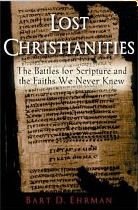
The Lost Christianities: The Battles for Scripture and the Faiths We Never Knew, By Bart Ehrman

(This review was posted on Amazon.com - January 20, 2004)Probably due to an undercurrent of anti-Catholic sentiment in the USA that began with the Puritans and can still be found among Protestant fundamentalists, there remains a dearth of knowledge and understanding of early Christianity. Ehrman, like a hide-n-seek friend jumping out from behind a bush, overwhelms the uneducated with a dizzying array of texts and obscure references from the first two “Christian” centuries. His point (which I agree with) is that these texts should not be so obscure, but have been “lost” or rejected by what he calls the “proto-orthodox.” This designation refers to the dominant Christian group in the first three centuries - church leaders and theologians, speaking for an accepted faith, and standing against abberant viewpoints. “Proto-orthodox” because some of the views of this primitive group ultimately were rejected by later orthodoxy as theological issues continued to be defined.

Ehrman successfully illustrates the diversity of early Christianity. This diversity began with the apostles and is alluded to in the first Christian history, the Acts of the Apostles. Chapter 15 of Acts indicates some resolution in what was a growing problem for the early Church - was the Christian message to be separated from Judaism, or were converted Gentiles required to follow the laws of Moses? Ehrman documents how this struggle continued into the next two centuries.

In particular, Ehrman reviews some of the evidence for the Ebionites (an early Jewish-Christian sect), Marcionites (an anti-Jewish/Old Testament and somewhat Gnostic sect), Christian Gnostics (as depicted by various documents advocating extreme asceticism), and the Montanists (a sect given to ecstatic utterance and apocalypticism). In addition, Ehrman cites various texts that did not make it into the New Testament canon and further illustrate the diversity of belief in the first three centuries: The Gospel of Peter, Acts of Paul, Didache, The Infancy Gospel of Thomas, The Gospel of Thomas, The Epistle of Barnabas, The Shepherd of Hermas, and The Gospel of Truth - this only represents around half the documents Ehrman cites.

While Ehrman does a fine job of introducing these various sects and documents (one of his stated goals), some of his underlying assumptions are dubious. Throughout this study he states that these non-canonical texts were rejected, scorned and burned. Clearly there were times when documents were rejected and burned, but every document has its own story for why it was not accepted, or disappeared. Ehrman says as much in the chapter on how the NT canon came to be, and he consistently gives a fair historical synopsis when he discusses a particular text, but he misrepresents this historical period by consistently commenting on documents being “lost, rejected, and/or burned.” It seems clear that Ehrman’s commentary is predicated on the thesis that these non-canonical texts were discriminated against in a patristic conspiracy. As Ehrman states in the chapter on the NT canon, there were a few NT documents that only made the canon after years of debate and consternation. In an alternate space/time continuum Ehrman (and others) would be moaning about the “lost” Christianities due to the rejection of the Gospel of John, Hebrews, and that strange little letter attributed to the brother of Jesus, Jude. These NT books contain shades of Philo/Middle Platonism, ebionitic christology, and Judaistic apocalypticism respectively. There was no way to have a canon that contained all the texts claimed by “Christians” - the only practical option was to “accept” the best texts and allow the others to drift slowly into the sands of time. There are too many conflicting pieces of evidence in both the non-canonical texts and in the patristic record for the conspiracy theory to hold up.

Another dubious assumption Ehrman makes is to assign more historical validity to these non-canonical sources than to the accepted NT texts. Against the NT record and all the writings of the early fathers, Ehrman wants us to believe the Acts of Thomas and the Gospel of Thomas which both claim Thomas as the twin brother of Jesus. Although Ehrman does not think this Thomas really authored the gospel in his name (p.57), he appears to accept the claim that Jesus had a twin brother, Didymus Judas Thomas (didumos being “twin” in Greek). But, if this Thomas was in fact a twin, he could have been the twin of James, rather than of Jesus. The twin brother theory is never even alluded to in the NT and, as far as I know, is not supported in any of the early fathers.

Again, in the Acts of Paul and Thecla we see extreme asceticism that goes against the Pauline record (1 Timothy) in the NT. Though Thecla is known to be a forged document, Ehrman believes these stories were not completely fabricated, “there are reasons for thinking that he [the forger] compiled stories he had heard, oral traditions that had been in circulation for years” (p.32). Belief in the conspiracy keeps Ehrman from granting the same latitude to the NT documents. Ehrman sees the Thecla stories to be more in line with NT Paul and the motivating factor for “Paul” to write 1 Timothy (p.39). So, we should consider the oral traditions behind Thecla to be more reliable than the oral traditions recounted by the fathers for Paul’s authorship of the Pastorals. Why? The Conspiracy.

More examples could be cited, but Ehrman states his presupposition, “Where did we get our New Testament Gospels in the first place, and how do we know that they, rather than the dozens of Gospels that did not become part of the New Testament, reveal the truth about what Jesus taught?” (p.93)

The victors write the history and there were socio/geopolitical struggles that influenced the NT writers, but does that mean we disregard anything they tell us? Five hundred years from now someone will find twentieth century Neo-Nazi writings defending the Nazi party of the 1940’s. Why would anyone believe this testimony over the writings of Winston Churchill or Dwight Eisenhower? Yet this is exactly what Ehrman seems to be advocating in Lost Christianities.

R.A. Baker
Ph.D. Ecclesiastical History


Comment Here:

You can submit a comment or ask a question using this simple form, or use our Contact/Feedback Form.
CH101 retains the right to edit and post comments/questions.
E-mail Address:
Please add comments below:
If you include links do not include "http:"


Like us on Facebook
Get update notification when new info hits CH101
CH101 Newsletter
CH101 Sponsors
Learn more


Emsisoft Anti-Malware
Get a FREE 30 Trial

Questions/Answers
- worship on sunday
- origen and universalism
- water baptism
- wine in ancient world
- fathers on NT Revelation
- fathers on holiness
- fathers on the military
- palestine or israel?
- candles in church
- pagan influences
- constantine-Sun worship
- constantine vs donatists

Book Reviews
- book reviews
- Buzzard - the Trinity

Biblical Issues
- pacifism and the NT
- who wrote NT Hebrews
- the trinity
- the apocrypha
- saul the persecutor
- NT, faith, resurrection
- NT and tithing
- Is the NT inspired?
- wine in the bible

Culture and Opinion
- muslim terrorism
- faith and certainty
- gay rights - a response
- end of the spear


- CH101
All rights reserved.
1st Century | 2nd Century | 3rd Century | 4th Century | Resources | Podcasts | Feedback Q & A | Site Map

Early Church Fathers - History
Reformers reject The Apocrypha
Origen and Universalism
Water Baptism - Early Church
Church Fathers and NT Revelation
Church Fathers Santification, Holiness
Sabbath and Christian Worship
Baptism Early Church Scholars
Constantine Christianity Sunday Worship
Paul Apollos Hebrews Philo
Jesus Paganism and Early Christianity
Constantine vs Donatists
Early Church Fathers and History
Early Church Fathers View Military Service
Early Church Fathers Military and War
Palestine in the Ancient World
Christian use of Candles in Worship
Christians and Pagan Influences
Sabbath Day Worship
Baptismal Practices in the Early Church
Constantine - Sol Invictus
Who Wrote Hebrews in the Bible?
Emperor Constantine Donatus
Church History - New Testament
The Apocrypha - New Testament
New Testament, Faith, and the Resurrection
New Testament and Tithing
Pagan Influences on Christianity
Hellenized Jews and Pagan Influences
Sabbath Day and Sunday Worship
Baptism in the Early Church
Emperor Constantine - Christianity
Constantine Led an Army?
Did Paul or Apollos Write Hebrews?
Church History Book Reviews
Bart Ehrman and Gnostic Texts
Bart Ehrman New Testament
David Bercot and Heretics
Hannah Whitall Smith
David Bercot and Church History
Keeping the Sabbath
Baptismal Practice - Early Church
Emperor Constantine the Great
Who Wrote Hebrews? Paul or Apollos
The Real Story of Constantine vs Donatists