CH101 Reviews - David Bercot Books
Pagan Christianity, by Frank Viola
Retrieving the Tradition, by D.H. Williams
CH101 Interview of D.H. Williams
Primitive Christianity and the New Testament
Did Jesus Exist?, by Bart Ehrman
Peter, Paul & Mary, by Bart Ehrman
Lost Christianities, by Bart Ehrman
A History of the Early Church, by Hans Lietzmann
Men and Movements, by F.F. Bruce
Will the Real Heretics Please Stand Up, by David Bercot
A Dictionary of Early Christian Beliefs, by David Bercot
The Doctrine of the Trinity, by Anthony Buzzard
The Christian's Secret to a Happy Life, by Hannah W. Smith
Flea Market Jesus, by Arthur Farnsley II
Movie Review: End of the Spear
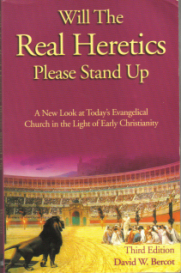
Will the Real Heretics Please Stand Up: A New Look at Today’s Evangelical Church in the Light of Early Christianity, by David Bercot
See reader comments and my responses below.]
I struggle with this book by David Bercot - as a critique of the evangelical church in America I would give this book 4 stars (out of 5), but as an historical glance at the primitive church it would only receive 2 stars. Yes, Bercot allows the early fathers to speak for themselves, but he fails to give the reader any historical context. He also only allows them to say the things he wants them to say - in other words, there are many other things these early fathers said that are not included because they either contradict his thesis or are not as flattering. I could lift numerous passages from the Gospel of Truth (we think Valentius was the author) that would sound great; I could also find numerous passages from almost any of the fathers Bercot used that would be far less flattering. Historical context is everything.
The Donation of Constantine and the Life of Sylvester are two documents that surfaced in the 8th century telling the story of how the Emperor Constantine came down with a form of leprosy, had no success getting help from his pagan soothsayers and called for Sylvester, the Bishop of Rome. Sylvester shared the gospel with Constantine and administered baptism. A day or two later Constantine was healed and in response he writes an edict "The Donation" in which he gifts the bishop of Rome with lands and wealth and bestows on him, as "The Chair of Peter," the leadership of all churches.
These documents had a significant impact on the Church from the 8th to the 13th century with various Popes and others leveraging these documents to garner wealth and political power. In the 15th century these documents were proven to be forgeries, but great damage had already been done. What DH Williams points out is how Reformers in the "Free"/Anabaptist movements used and made negative references to these documents AS IF they were true. Williams indicates that at least some of these men did this without knowing the documents were forgeries. This negative view and tone against both Constantine and his influence on the Catholic Church still influences anabaptist and "free" Protestants to this day.
Bercot never mentions The Donation of Constantine and I am not suggesting that it was needed. I am not sure if that means he knows about it and has been affected by the improper use of it in the Reformation, OR if knows nothing about it. [2014-03-13: I have been informed that he does know about "The Donation" and does know that it was a forgery.] Bercot is in the anabaptist movement and I believe has been affected by this 8th century forgery. Knowing the truth about "The Donation" does not easy overcome years of anti-Catholic, anti-Constantine thinking.
After my critique of a similar work someone sarcastically wrote to me, “…You think nobody can possibly read the early fathers and understand them. I guess we all need a Ph.D. to be able to understand anything.” I certainly do NOT want to give anyone the idea that only pinheaded Ph.D.s can read/understand the early fathers, but it is not an easy task. Most of us have some idea of what the apostle Paul means when he tells women not to cut their hair, and tells the men not to wear their hair long. While commentaries on 1 Corinthians are fairly easy to find, very few people have scholarly works sitting on the shelf to help them understand what Tertullian means when he describes how to deal with “sinners” in the church,
…when you lead the penitent adulterer into church to beg the intercession of the brethren, place him on his knees in their midst, covered with sackcloth and ashes, in an attitude of humiliation and fear, in the presence of the widows, in the presence of the priests, moving all to tears, kissing the footprints of all, embracing the knees of all. On Purity 13
Because I do not want to come across as demeaning, I want to be careful not to critique each and every issue I disagree with in this book. I will mention the places where I agree with Bercot, and I will try to illustrate why I disagree on some issues. My overview of Bercot is that he takes a very simplistic reading of these early writers. My primary methodology will be to give examples from these writers that either contradicts, or shows a different angle, from what Bercot reports.
Bercot’s introduction is the martyrdom of Polycarp - it is almost impossible to criticize the use of this inspiring passage. In chapter 2, however, Bercot reveals what to me is a telling predilection when he says,
“…these men were not church fathers! Most of them were fairly ordinary, hard-working Christian leaders with above-average education. They would have been highly indignant at being called ‘church fathers.’ The only ‘church fathers’ they recognized were the apostles.”
This statement is silly. I guess Bercot is anticipating, and playing to, an anti-Catholic bias in his audience. Maybe for Bercot and his audience the term “church fathers” is a four-letter word. The second century fathers certainly would not have considered themselves to be “fathers” - they only became fathers in the next few centuries! As a good friend suggested, these men could not have been “fairly ordinary” in the ancient world if they had an “above-average education.” The overwhelming majority of the population was illiterate. Indeed, most of these early church fathers were far from ordinary men - they had great minds (Justin, Tertullian, Clement and Origen); they were obviously not ordinary since they were leaders in the church; and they ARE now known as “fathers” precisely because they were extraordinary.
In Chapter 4 Bercot begins his direct critique on 20th century North American evangelicalism (remember this book was written in 1989). I basically agree with many of his comments regarding divorce and abortion - if he were writing now he might criticize the basic evangelical position on homosexuality. I have my own concerns regarding feminism and the effect this issue has had on American Christian men, but Bercot’s comments on women in chapter 4 reveal his lack of understanding of both the biblical text and the ancient world.
I realize this borders on being an academic pinhead for some people, but Gordon Fee released his commentary on 1 Corinthians in 1987 where he showed, quite convincingly, that the “women shall keep silent” passage in 1 Cor 14 almost certainly was not in the original Pauline letter. Because of this it is problematic to use the complimentary text from 1 Timothy since most non-conversative scholars doubt Pauline authorship of that NT letter (the fact that I DO hold to Paul’s authorship does not change my mind that this is NOT a good argument from the biblical text). Bercot’s comments regarding women in the ancient world are stunning - is he really saying that women were seen as equals in the Greco-Roman world?
“But Roman women were hardly known for their submissive character. As one Roman commented, ‘We rule the world, but our women rule us.’” When I read this I found myself thinking, “Who said that?” I followed the footnote and found that Bercot is citing a secondary work…and only gives us the page number! Bart Winer said this on page 176!? This is Bercot’s ONLY scholarly notation for making such a claim.
The New York Times calls Winer's book, Life in the Ancient World "a children's book." Bercot should at least tell the reader who in the Roman world said this. You can see this "citation" in Winer's book using Google Books. Winer uses quotation marks, yet does not tell the reader who said this. We must remember, it is a children's book. Winer did not properly cite his work, and Bercot should not use this as a reference. Bercot is using a children's book as a reference!
He says that the early church went against the ancient culture by denying women any role in leadership. I would say that the apostle Paul went against Greek, Roman, and Hebrew culture by OPENING the doors of leadership to women. It was the early church that went against the Pauline tradition left to us in the New Testament.
Chapters 5 and 6 are basically just “good preaching.”
“This was one of the secrets of the early Christians. They were able to reject the ungodly attitudes, practices, and entertainment of their culture…” p.42
It becomes clear reading these chapters that Bercot is Wesleyan, or anti-Reformed, in his theology. Bercot wants to challenge evangelicals to shun what Bonhoeffer coined “cheap grace.” I agree with this challenge, but do not like using these early writers for support. Each of these early church fathers had their own challenges: Clement of Alexandria did cite the New Testament quite a lot, but he also cited, and was heavily influenced by, Plato as well. Although he attacked the Gnostics, he embraced some aspects of Gnosticism. Tertullian stays away from Greek philosophy, but he holds a very strict view on repentance and restoration - he actually joins the Montanists (the group Bercot calls heretical on page 37). Yes, Tertullian joined the sect that had women serving in leadership. He eventually left the Montanists because they were also too “liberal,” and started his own group.
At the end of Chapter 6 (pp.66-67) Bercot tells us that the Gnostics preached salvation by grace alone. I have read and studied 15 or more Gnostic texts, and I have read numerous scholars whose expertise is Gnosticism - I have never heard Gnostics referred to in these terms. Gnostics believed that salvation was obtained through learning gnosis, knowledge. This knowledge helped them traverse through the heavenly levels by equipping them with secret passwords. Salvation through grace alone? I have never seen or heard anything in Gnostic texts that made me think of salvation by grace alone.
Tertullian is one of the strictest second century fathers yet he says this regarding the struggle against sin,
“It is a fact that there are some sins which beset us every day and to which we all are tempted. For who will not, as it may chance, fall into unrighteous anger and continue this even beyond sundown, or even strike another or, out of easy habit, curse another, or swear rashly, or violate his pledged faith, or tell a lie through shame or the compulsion of circumstances? In the management of affairs, in the performance of duties, in commercial transactions, while eating, looking, listening - how often we are tempted! So much so that if there were no pardon in such cases, no one would be saved. For these sins, then, pardon is granted through Christ who intercedes with the Father.” On Purity 19
In Chapter 7 Bercot attacks the doctrine of Predestination. One of his targets seems to be Martin Luther. I have never read/heard Luther attacked for predestination and I have no idea if he held to this position. [Added 2014-03-12: A reader made me realize an oversight here. Luther was an Augustinian monk, thus most likely DID hold to predestination. My comment here is to say that I do NOT know much about Luther. My review of, and problem with Bercot, is not theological. My problem is Bercot using these early fathers. See reader comments and my responses below.] I agree with Bercot that the second century fathers did not promote predestination, but a significant part of his argument comes from a lengthy passage in Origen’s On First Principles. In this same document Origen presents his speculative theory of universalism. This is one of several issues that led to the “Origenist controversy” which caused problems for several centuries. For Bercot to use anything from this document seems ironic at best.
Chapter 8 is on baptism. Bercot basically maintains that evangelicals have marginalized water baptism. I agree with him for the most part.
Chapter 9 is on prosperity and the “name it, claim it” doctrine that was far more popular in the 80’s. Again, I basically agree with Bercot on his criticism, I just would not use these early Christian fathers as evidence. As I mentioned earlier, these men were NOT ordinary. Few believers had wealth in the second century - most were of the lower class. But there were wealthy believers who did not give away all of their possessions and were not urged to do so. One interesting point is that Bercot uses a quote from Clement of Alexandria’s “Who is the Rich Man Being Saved.” It might be interesting to hear a few of the points Clement gives in that treatise.
“Who is the Rich Man” is basically Clement’s commentary on the story of the Rich Young Ruler as told in Mark’s gospel. It is important to remember that giving away one’s possessions to live in poverty (or at least to live a very simple lifestyle) was not something new in the day of Clement, or during the time of Jesus for that matter. Neo-Pythagoreans, most notably Apollonius of Tyana, promoted a rigorous asceticism which included a rejection of material possessions. Clement does his best in all his writings to make Christian faith THE best philosophical system, so he tends to take some positions that appear to go against typical orthodox thought if it will help him accomplish his desired goal. He also has in mind the Montanist movement which also advocated the rejection of material worldly goods in favor of the heavenly kingdom that was to be quite immanent.
In chapter 13 Clement argues that the Lord enjoins us to “give drink to the thirsty, bread to the hungry, to take the houseless in, and clothe the naked,” but Clement goes on to say that this is impossible to do IF you have given ALL of your material possessions away:
Riches, then, which benefit also our neighbours, are not to be thrown away. For they are possessions, inasmuch as they are possessed, and goods, inasmuch as they are useful and provided by God for the use of men; and they lie to our hand, and are put under our power, as material and instruments which are for good use to those who know the instrument. If you use it skilfully, it is skilful; if you are deficient in skill, it is affected by your want of skill, being itself destitute of blame. Such an instrument is wealth. - Rich Man 14
So that (the expression) rich men that shall with difficulty enter into the kingdom, is to be apprehended in a scholarly way, not awkwardly, or rustically, or carnally. - Rich Man 18
The point is that Clement of Alexandria is presenting the case that it is not always good to give away all of your riches - there is a place in the faith for people with great wealth. This, of course, is why I find it ironic for Bercot to use this document without giving the reader any historical context.
In Chapter 10 Bercot focuses on the proper Christian attitude towards war.
I want to give an overview of his mistake.
Bercot does admit that “the early church made no law that Christians could not serve in the army…Neither Jesus nor the apostles ever strictly forbade Christians to serve in the military,” but he goes on to say that the empire was experiencing peace during the second century and soldiers were more like police officers. (p.97) This is an absurd argument.
Here is the historical context: every 20 to 40 years Christianity would get slapped around. Pastors and bishops would be arrested, thrown in jail, and some would be executed. Laypeople would be tortured and forced to sprinkle salt on the altar to the empire at the risk of being thrown to wild animals in an amphitheatre. Roman soldiers were known for their cruelty in battle, but they were also known for their cruelty towards Christians during these times of persecution. Even during times of peace Roman soldiers had license to make harsh demands on average citizens.
With this context in mind, why would Christians be encouraged to serve in the military? The citations used by Bercot are each commenting on military service for Rome, not military service or warfare in general. I know a man who was a pastor in Cuba when Fidel Castro led the Communist takeover. He fled with his family, but many of his friends were ripped from their beds in the middle of the night, beaten, imprisoned, and some killed. Would it surprise anyone if Christians in Communist Cuba were discouraged from enlisting in the military after the takeover? You cannot compare military service in modern-day USA with the Roman empire. You might disagree with Korea, Vietnam, and Iraq; you might think the USA is imperialistic, but you simply cannot objectively compare soldiers in the USA to those in the Roman empire in this way.
[This section edited Dec 13, 2009]
Some of the early fathers discouraged military service (mainly Tertullian), but they also did not encourage believers to be involved in politics or acting. Overall, they speak negatively about politics. Does this mean that we should discourage believers from serving in the political arena as well? The problem with this is that the New Testament does not have this prohibition against military service or politics. As much as I respect the early fathers, the NT is our primary (not the only) authority when it comes to the teaching of the apostles.
In fact, we are given a fairly positive view of military service in the NT.
- Jesus heals the daughter of the Roman centurion with no indication of displeasure for his military service - Luke 7:1-10
- Peter shares the gospel with Cornelius - Acts 10
- Paul refers to believers in the household of Caesar - Philippians 4:22
- Paul uses soldiers as a positive analogy - 1 Corinthians 9:7; Philippians 2:25; 2 Timothy 2:3-4.
But I want to further address Bercot's mistake. As with many other issues, Bercot only presents one side of the data. In his presentation he cites Tertullian's treatise The Crown where he tells the story of a Christian soldier who refuses to wear the appropriate headress laurel with his fellow soldiers. He is mocked, stripped of his commission, and imprisoned to await death. But this treatise itself shows that Christians were, in fact, serving in the military.
Eusebius tells us that Christians were serving in governmental positions and in the army long before Diocletian. (Church History 8.1) He mentions that some Christians were allowed to refrain from sacrifice (8.3) apparently being shown preferential protective treatment. Lactantius tells us that Christian attendants to Diocletian made the sign of the cross while fortune tellers were trying to divine the future for the emperor, thus causing the soothsayers difficulty. Diocletian demanded that these Christians be whipped. He also sent orders to his commanders that all Christians serving in the military be made to offer sacrifices or be dismissed from service. (Of The Manner in Which the Persecutors Died 10.6)
These examples show that although Tertullian was against military service, the early church did not have a concensus view. This is typical of early Christianity - there is diversity of opinion and practice on many, many issues. Bercot fails to appreciate the evidence for this in the data or just fails to present this evidence to the reader.
Chapter 11 is titled “Who Better Understands the Apostles?”
Bercot basically argues that these second century fathers are better trusted than we are to interpret the NT writings. He points to the early testimony of those like Clement of Rome and Papias who had opportunity to hear some the apostles. Bercot then mentions oral tradition, but tries to say that there was no oral tradition beyond what we have in the NT. This position is a very difficult one to defend - there are several documents in early Christianity that were not accepted into the NT canon, each containing snippets of what were most likely early traditions. Clement of Alexandria (Strom I.1.11-13) and Origen (Celsum VI.6) both affirmed oral traditions that were not contained in the written texts.
It is also amazing that Bercot cites Papias, then goes on to marginalize oral tradition - this is exactly what we have in Papias - early oral traditions about the apostles. Papias states that he is not so fond of "things out of books," but that he preferred "the utterances of a voice which liveth..." (Eusebius CH 3.39,1-4) Funny, Papias marginalizes written tradition in his written document, The Sayings of the Lord Explained.
The remainder of Bercot's book is basically an attack on Constantine, Augustine, the Nicean Council, and everything else Catholic. Bercot argues that the second century church was far more dedicated, yet the writers he uses complain in many places about the worldliness of the church in their day. Were there growing problems in the church after the second century? Yes, as the church grew numerically and into new cultures, and as church leadership became more bloated problems increased. Theological issues and debates developed due to heretical movements - a growing theology led to theological disputes.
My overall critique of Bercot’s book is this: he wants to point to the second century church as some kind of ideal that we should attempt to emulate. While I think there are positives to be seen in every era of church history, I do not think the second century, or any other era, should be pointed to as the “ideal.” In addition to the various specific critiques I have offered, the second century writers also held numerous doctrinal positions that Bercot would NOT want us to embrace: purgatory (Origen), mortal and venal sins (Tertullian), forgiveness of sins rests with the bishop (Ignatius, Cyprian), and many others. It appears to me that Bercot takes the Early Church Fathers on CD and does a “Ctrl + F” to “Find” passages that speak to a particular issue. If he likes the passage, he uses it. If the passage does not support his thesis, he ignores it.
The writings of the early church fathers must be used with care. Historical context is critical.
R.A. Baker
Ph.D. Ecclesiastical History
Having known David Bercot, I can tell you that he knows about the Donation of Constantine. He was the first one to tell me about it, and he called it a forgery. I have done some research on it since, but middle age documents are not really my area of study.
The reason Bercot doesn't mention the Donation is because it's irrelevant to Will the Real Heretics Please Stand Up, which is a simple survey of 9 particular early Christians, all pre-Nicene.
I've had my own conflicts with Bercot because he's often not precise. He makes generalizations that have turned out not to be true. In the early days, when he wrote the Heretics book, he was still pretty strongly influenced, in my opinion, by his Jehovah Witness [history].
On the other hand, I think your criticism of the book, though accurate in many ways, doesn't really touch on the main point of the book. The main point of the book is to address the fact that evangelicals, when confronted with the teachings of the pre-Nicene fathers, usually regard them as heretics who are too legalistic and ritualistic. Who are the real heretics? Us, the evangelicals, or the early Christians? I think his theme is both solid and accurate...
I'm somewhat puzzled by your answers to chapter 7 on predestination. Martin Luther wrote a book called The Bondage of the Will. His stance on predestination against free will is pretty strong in that book because he was raging against Erasmus. And the pre-Augustinian emphasis on free will is ubiquitous in pre-Augustinian writings. I have a quote page with just a few quotes, but I could multiply those quotes by 10 without much effort.
Otherwise, I think you have some good points. Like I said, I have my own problems with Bercot, but I think even after those points are made, Bercot’s main thesis is accurate and extremely important.
My Response:
Thank you for responding to me.
No, I would not expect Bercot to deal with the Donation in that text. My point was to say that his Anabaptist viewpoint had been jaded by the Donation having been reported by Reformation Anabaptists AS TRUE. DH Williams documents this inaccurate reporting of historical data.
I also agree that Bercot's prior training with JW's also has influenced his view. Knowing that the Donation of Constantine was a forgery does not erase an anti-Constantine, anti-Catholic perspective if one has held that perspective for years. It took me around 10 years of study around the edges until I was then confronted with the actual documents from which we get our historical data.
Now look, I remain a Protestant. In fact, I remain in my heart a non-sacramentalist, non-liturgist. This does NOT mean that I disdain or discount these views/practices...I just personally do not feel compelled to participate in these aspects of community and worship. When I am worship with a liturgical community I am fine participating and feel edified. It's just not something I feel is essential, obviously, or I would be in a community reflecting that perspective.
My problem with Bercot's presentation is that it is not close to being exhaustive. He only presents the data from the early church that agrees with his particular point which he is making. The early church fathers were all over the map on most issues. They were certainly NOT in lockstep, not in unity no matter what the Catholics or the Orthodox say. I think I did a fairly good job of showing how Bercot's points are contradicted by other data which he either has ignored or is not familiar with.
I open with this statement: "... as a critique of the evangelical church in America I would give this book 4 stars..."
I have recently been called a heretic (nobody has ever said that to me) by an Orthodox priest. I would not call many of the early fathers heretics (not keen of calling Arius a heretic), nor would I quickly call someone a heretic in modern times. I am not a fan of being dogmatic...except that I am dogmatic about presenting early church history
accurately.
I have just read my review again, and indeed, I need to make some edits. It is not as clear as it could have been - that is why academics go over stuff multiple times prior to publishing and is why publishing on a web site (as I have done) is somewhat problematic. I get impatient and put stuff out there that is not really as tight as it should be. You have helped me. Thank you.
To reply to:
"...I'm somewhat puzzled by your answers to chapter 7 on predestination..."
My first point is simple: I am NOT competent on Luther. My expertise is the first three centuries. Thinking about it now, Luther was an Augustinian monk, thus it is probably a very good guess that he agreed with Augustine. I need to edit this. But my point here was simply to say that I do not know about Luther. I have not read anything by Luther. This may shock you or dismay you, but there are MANY things I do not know. I try to be open and honest when I do not know something. THIS is something that would help Bercot. And leads to my point about Bercot and one that I think you might be missing.
I agree with several positions that Bercot takes - I just think he is mistaken to use early fathers to bolster his positions or prove his points. My comments on Chapter 7 that puzzle you shows my point. You seem to want me to comment on predestination. Commenting on theology is NOT my concern in the review of Bercot.
My point here is that in a book on "heretics" where Bercot is presenting early fathers as "normal" and modern evangelicals as "heretical," to give evidence for his view against predestination he cites Origen's "First Principles!!!"
This particular work of Origen led to so many conflicts and heated debates. It helped pushed the church to the Great Schism as the Eastern Church always esteemed Origen more than the Western Church in many areas of theology. Origen presents a view of universalism in this treatise - yet Bercot cites a lengthy passage from
"First Principles."
Maybe it's just me. Maybe this kind of simplistic use of the fathers is ok. Cite Origen and stand strong with him when he agrees with you. Ignore him when he goes against you or even says stuff that you would 100% reject. THIS is my problem with Bercot. Did he know this about Origen's "First Principles" when he wrote this book? It's just difficult to take him seriously when he does this, and he does it over and again.
He wants to take a hard stand against "sin." Reminds me of the holiness movement. This is somewhat consistent with someone who rejects Reformed/predestination theology. Like others I have criticized, he probably (cannot remember and my copy is packed in Texas) loves to quote Tertullian, who held a strict view against sin. Yet (as I point out in my comments on Chap 6) "On Purity" Chap 19 Tertullian basically admits that we all sin - he does not say "daily in thought, word and deed," but if you read his text you could see how the Westminster Confession can "see" their view in this text.
My Comments on Chap 9:
Bercot uses Clement's "Rich Man" treatise?!?
Again, I find it stunning. Again, I might be mistaken (although I doubt it - I read and took good notes on Bercot's book as I tend to do when writing a review), but Bercot is using "Rich Man" to show that the early church promoted selfless living and urged people away from materialism. As I said, I basically agree with Bercot's point, but to use Clement's "Rich Man" is just...I sit here trying to find the right adjective...stupid comes to mind. Again, either Bercot does NOT know Clement's treatise OR he uses it to bolster his position without telling the reader this problem.
Look, my point to Bercot is this: If you want to write a book criticizing modern evangelicals - Just do it. But don't use early church fathers when you are not qualified
to use them. It would be like me glibly citing Martin Luther when I really do not know his writings. Oh I have read about Luther. I have read short excerpts of Luther, but
I would NEVER try to use Luther as some kind of proof, especially for theology (another category I am not competent to speak on as an authority).
Many have read Bercot and now think they know something about the early church when all they truly know is the small amount Bercot reveals of what he knows. And Bercot seems to know probably 20% of what I know...and I know such a very small amount about the first three centuries of Christian history...and I have a Ph.D. from a world leader in academic study. And I am not trying to be humble. I KNOW how little I know. My supervisor was an expert in Augustine. I would go across the street for a cup of tea with him, sit for 1-2 hours and just ask him questions about church history. It was awesome, but also very, very humbling and a bit discouraging. I hope I know 20% of what he knows.
Al B.

Questions, Comments or Criticisms:
You can send an email to directly to me Al Baker, CH101.
CH101 retains the right to edit and post comments/questions unless you specifically ask that your comments NOT be posted. Comments that are personal or private are never posted...only questions about Church History, the Bible, etc.
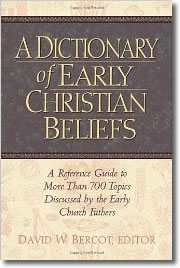
A Dictionary of Early Christian Beliefs by David Bercot
Review by R.A. Baker, Church History 101
This is my second Bercot book to review. For the novice this is an impression text and can serve to expose him/her to the writings of the early church. As an historian of the early church I have a few cautionary notes to the lay person new to these writings.
First, Mr. Bercot is not an early church historian - he is a lawyer. Because of this Bercot offers a very limited view of the early church. I salute his desire to allow the fathers to speak for themselves, but for the novice this can be very difficult - the fathers are not easy to read nor are they easy to understand. A good historian must give some historical context to the reader to help understand and explain the readings. Bercot does little of this in this text.
The Ante-Nicean Fathers Series is Inadequate
The collection Bercot uses is incomplete. Although it is the 10 volume set (somewhat overwhelming to read), there are many early church texts not found in this set. More than that Bercot's sample of citations can only present the topics in a brief summary fashion. For example, "Baptism" covers 12 pages, but the section on "Baptism by Heretics" is only 2 pages. Bercot focuses his coverage on the basics about baptism: Christians believe in baptism, the mode of baptism, etc. Baptism is an important topic, but the BIG issue in the early church was whether someone coming from a "heretical" sect needed to be baptized again, thus rebaptism. It is understandable that Bercot does not try to cover this because it gets complicated. That is partly why this "Dictionary" is inadequate - the early church was filled with diversity of opinion. A dictionary such as this can easily lead a church history novice to think there was more unity of thought than truly existed. Fathers disagreed on many things and sorting through each issue is just not easy.
Bercot only cites Volume and page number. He should have also given the document name and at least the Book, Chapter notation. It is always important to know which treatise is being quoted - at the very least is it helpful when someone wants to read the text in context. The ANF notation is not a good one at all.
The Early Church was not in 100% Agreement
Bercot leaves out some critical issues. I will admit that this "Dictionary" was a massive undertaking and the overall topical selection is not among my biggest concerns. At 704 pages it does contain a lot of material, but there is little reference to some of the critical disagreements between fathers which is essential to understanding the early church. There is almost nothing about "second repentance" or "monopiscopacy." There is a total of just over one page combining "Ebionites" with "Jewish Christianity," yet this was a very important issue moving from the first to the second century. One page on Arius? Arianism was the major reason for the calling of the Nicean Council! But again, in such a massive undertaking you cannot cover everything.
Second Repentance
I do want to focus on "second repentance" for a brief moment. This was a very important issue in the early church with several fathers addressing it: Shepherd of Hermas, Clement of Alexandria, Tertullian and Cyprian just to name the main writers (I would be surprised if there are not others who at least commented on the topic). In brief, it was the debate as to whether a Christian who had "lapsed" (committed some kind of serious sin) after baptism could be declared forgiven by a bishop, martyr or by anyone. This issue of lapsed believers was typically in the forefront AFTER a period of intense persecution. Some would fail the test and declare allegiance to the Emperor ("Caesar is Lord") while others would simply fall into other sins during a period when the formal public meetings were suspended.
Bercot includes some of the key texts on "second repentance" in his section on "Repentance," but it is easy to read these without knowing ANYTHING about the historical context. Montanism was part of this discussion and Bercot actually includes some texts from Tertullian that speak to "second repentance," but Tertullian's view is somewhat nuanced. Bercot includes some of this nuance under "Sin/Classes of Sin" (Tertullian is the first Christian writer to make the distinction between "mortal" and "venial" sins). The texts reflect Tertullian's anger that bishops would grant absolution of sins. However, the selective citations fail to show that Tertullian DOES acknowledge the possibility of forgiveness even for "mortal" sins (On Purity, Ch.3) - he just maintains that the bishop cannot grant forgiveness.
In the end I am torn with this Bercot text: I like the idea of exposing Christians to the early fathers, but with my reservations given above. I doubt anyone could have done a great job with such a volume, but I am not sure "A Dictionary of Early Christian Beliefs" is even a good idea.
R.A. Baker
Ph.D. Ecclesiastical History
Questions, Comments or Criticisms:
You can send an email to directly to me Al Baker, CH101.
CH101 retains the right to edit and post comments/questions unless you specifically ask that your comments NOT be posted. Comments that are personal or private are never posted...only questions about Church History, the Bible, etc.
Questions/Answers
-
was athanasius black
-
tertullian/paul/marcion
-
worship on sunday
-
origen and universalism
-
water baptism
-
wine in ancient world
-
fathers on NT Revelation
-
fathers on holiness
-
fathers on the military
-
apostolic succession
-
palestine or israel?
-
candles in church
-
pagan influences
-
constantine-Sun worship
-
constantine vs donatists
Book Reviews
- church traditions
- book reviews
- Buzzard - the Trinity
- David Bercot books
Biblical Issues
-
what is false doctrine?
-
pacifism and the NT
-
who wrote NT Hebrews
- the trinity
- the apocrypha
- saul the persecutor
- NT, faith, resurrection
- NT and tithing
- Is the NT inspired?
- wine in the bible
Water Baptism in the Early Fathers
Baptism in the Early Creeds - Second Repentance
Evidence on Water Baptism in the New Testament
Water Baptism is NOT Required for Salvation
You Cannot Take Every Word of Jesus Literally
- christian tolerance
- faith and certainty
- PragerU - Canada
- end of the spear

Does Tertullian call Paul "The Apostle of the Heretics?"
Did the Early Church believe in Universalism?
When was Jesus born? How did the calendar get confused?
What was the Early Church belief about Water Baptism
Water Baptism in the Book of Acts - More Comments
Palestine - Philo, Josephus, Strabo, Aristotle
Was the Wine in the Bible Alcoholic?
Apollos NT Hebrews in the Bible
Was Wine in the Bible Alcoholic?
James the Just and Jesus in the Bible
Tertullian - Apostle Paul - Marcionism
Is the Apocrypha Inspired?
"one baptism" in the Nicean Creed
Did the Church Adopt Paganism?
Early church Fathers and the Revelation
Church Fathers on Military Service
Review-the Real Heretics, Bercot
Errors in Viola's Pagan Christianity
Water Baptism - the Early Church
Sabbath or Sunday - Early Church
Is Water Baptism Salvivic?
Three Protestant Myths of Early Christianity
Did Constantine Kill Christians?
Were Candles used in the Early Church?
Did Apollos or Paul Write Hebrews?
Review on Buzzard and the Trinity
Did Constantine Worship the Sun?
Was the Wine in the NT Grape Juice?
Is Pacifism Supported in the NT?
What is the NT Evidence of the Trinity?
Is Tithing in the New Testament?
What is False Doctrine?
When did Apostolic Succession Begin?
What were Bishops like in the Early Church?
DH Williams on Church Tradition
Has the Biblical Text been Changed?
The Death of Constantine - Julian the Apostate
Jovian - Valentinian I and Valens
Christianity Official Religion - Edict of Thessalonika
FR