How Did the Early Church Fathers View Military Service?
Updated: February 17, 2015
 Pacifism, the Military and Christianity
Other links on Pacifism:
Pacifist vs Just War Debate
Pacifism and the New Testament
The Church Fathers and Military Services
CH101 eBook
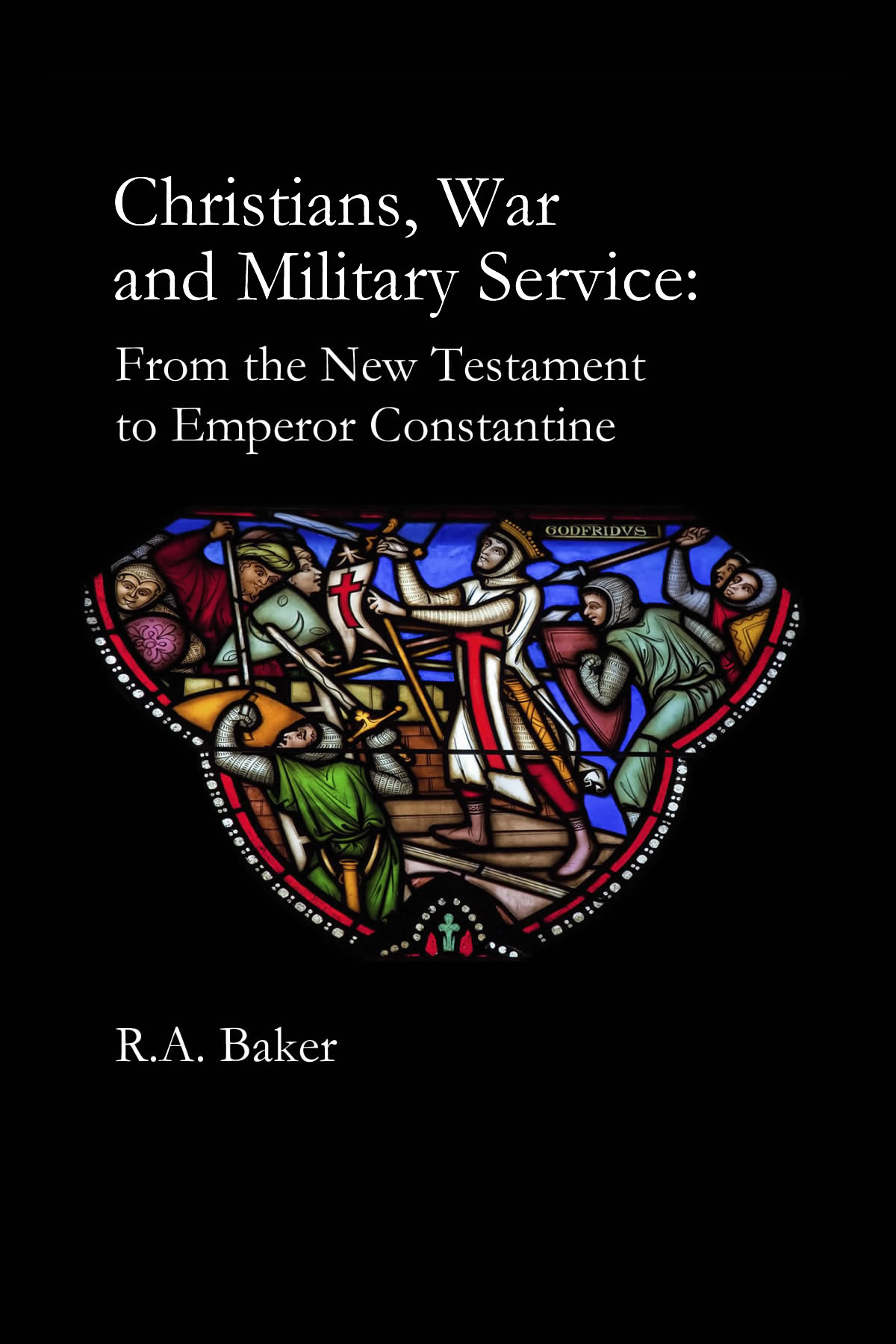
Christians, War and
Military Service: From the New Testament to Emperor Constantine
Christian Pacifism: While I do think pacifism, based on select teachings from Jesus is a valid position, I have heard from so many who hold this view trying to promote the concept that the early DID NOT serve in the military prior to Constantine. Unfortunately, the latest news of radical Muslims is making the pacifistic view dangerous - those who stand in judgement against the "Just War" theories developed in the ancient Church AND are using the early church to bolster their views are wrong.
This post is a concise overview of a 110 page study by John Helgeland, "Christians and the Roman Army from Marcus Aurelius to Constantine," ANWR 2.23.1 (1979), pp.724-834. This article is unfortunately not easy to get - I am happy to share parts of it to those who want to engage the argument. I have augmented Helgeland's information with some of my own research/comments. We MUST present the historical data accurately - Helgeland does a great job of presenting the data. You can see Helgeland's outline here.
This page initially started as a result of people sending me comments from David Bercot's book - Bercot has written a few books on early Christianity, the early church, and the early church fathers. I have real issues with Mr. Bercot and his methodology of research and presentation - you can read my review of his text, Will the Real Heretics Please Stand Up to get a full presentation of how he misrepresents the early fathers. Since originally starting this web site I have had several e-mail exchanges on this issue - many Christian pacifists have stated that the early church did not approve of Christians serving in the Roman military. Bercot's objective was to offer a critique of modern Protestant Christianity - and I agree with much of what he says. Pacifists usually have good theological and ethical points to make. Fine. Just do not misrepresent the historical data.
David Bercot does admit that "the early church made no law that Christians could not serve in the army...Neither Jesus nor the apostles ever strictly forbade Christians to serve in the military," but he goes on to say that the empire was experiencing peace during the second century and soldiers were more like police officers. (p.97)
Here is the historical context: every 20 to 40 years Christianity would come under persecution and get slapped around. Pastors and bishops would be arrested, thrown in jail, and some would be executed. Laypeople would be tortured and forced to sprinkle salt on the altar to the empire at the risk of being thrown to wild animals in an amphitheatre. Roman soldiers were known for their cruelty in battle, but they were also known for their cruelty towards Christians during these times of persecution. Even during times of peace Roman soldiers had some license to make harsh demands on average citizens. In addition, to be in the Roman army almost demanded making an oath to the greatness of the Emperor and offering sacrifices to his patron god. This was idolatry.
With this context in mind, why would Christians be encouraged to serve in the military? The citations used by Bercot are each commenting on military service (or joining the army) for Rome, not military service or warfare in general. I know a man who was a pastor in Cuba when Fidel Castro led the Communist takeover. He fled with his family, but many of his friends were ripped from their beds in the middle of the night, beaten, imprisoned, and some killed. Would it surprise anyone if Christians in Communist Cuba were discouraged from enlisting in the military after the takeover? You cannot compare military service in the modern-day army of the USA with the Roman empire. You might disagree with Korea, Vietnam, and Iraq; you might think the USA is imperialistic, but you simply cannot objectively compare soldiers in the USA to those in the Roman empire in this way.
Some of the early fathers discouraged military service (mainly Tertullian, but we will see below that his position was not consistent), but they also discouraged believers from involvement in politics, acting, teaching "worldly" knowledge, the gladiator games (or ANY "sport" in the coliseum). Overall, they speak negatively about politics. Does this mean that we should discourage believers from serving in the political arena as well? The problem with this is that the New Testament does not have this prohibition against joining the army or politics, or sport.
In fact, we are given a fairly positive view of military service in the NT.
- John the Baptist tells Roman soldiers to be content with their wages - Luke 3:14
- Jesus heals the daughter of the Roman centurion with no indication of displeasure for his military service - Luke 7:1-10
- Peter shares the gospel with Cornelius with no sign of telling him to resign - Acts 10
- Paul refers to believers in the household of Caesar - Philippians 4:22
- Paul uses soldiers as a positive analogy - 2 Timothy 2:2-3; 1 Corinthians 9:7; Philippians 2:25; 2 Timothy 2:3-4.
Evidence from the Early Church
Evidence of church fathers being against Christian serving in the military can only be found in fairly random comments. There are very few early fathers who focus on this issue. While the pacifist advocates say this lack of comment is due to an obvious stance against war and Christians in the military, the few examples we have cannot support this position. What we find is that while some fathers make statements against Christians serving in the military, there are more clear pieces of evidence that a growing number of Christians were serving as soldiers. This is similar to the apostle Paul urging Christians not to "get drunk with wine" as a signal that indeed some Christians were guilty of this activity. In other words, while a few leaders offer a negative tone, this was not the overwhelming opinion in the early church.
Tertullian is the first early father to make any significant comment about the Roman military with reference to the Church. It must be remembered that Tertullian lived in North Africa, a region which had experienced brutal military activities. The North Africans were not fond of Rome and it's military power - Tertuallian followed in this mentality. Yet in his Apology he says that Christians pray for the empire and for the emperor's success:
Without ceasing, for all our emperors we offer prayer. We pray for life prolonged; for security to the empire; for protection to the imperial house; for brave armies, a faithful senate, a virtuous people, the world at rest, whatever, as man or Caesar, an emperor would wish.
So Tertullian says that we should be praying for the success of our leaders AND their armies. Tertullian knew full well that the "security" of the empire rested on God's sovereignty, but also on the strength of the "brave armies." Apology 30.4
He also admits that Christians are found in all areas of Roman life, including "the very camp," referring to military camps. (Ap 32.1) In another writing Tertullian makes a famous reference to Christian soldiers during a battle in 173 AD:
Marcus Aurelius also, in his expedition to Germany, by the prayers his Christian soldiers offered to God, got rain in that well-known thirst. When, indeed, have not droughts been put away by our kneelings and our fastings? Ad Scap 4.6
Eusebius relates this same story, giving additional details:
It is reported that Marcus Aurelius Caesar, brother of Antoninus, being about to engage in battle with the Germans and Sarmatians, was in great trouble on account of his army suffering from thirst. But the soldiers...kneeled on the ground, as is our custom in prayer, and engaged in supplications to God. This was indeed a strange sight to the enemy, but it is reported that a stranger thing immediately followed. The lightning drove the enemy to flight and destruction, but a shower refreshed the army of those who had called on God, all of whom had been on the point of perishing with thirst. H.E. 5.5.1-6
Later in his life Tertullian becomes bitterly opposed to the empire and to Christians serving in the military. He had probably heard terrible things about the persecutions of Severus in Egypt, circa 200-203 AD. What becomes clear, however, is that his frustration is not with war, violence and killing - he is concerned with the idolatry in the military camps and knows that Christians would be tempted or pressured to engage in idolatry. The Roman military was a very religious subset of Rome: most commanders engaged in worship of some kind prior to battle, hoping to gain victory. It makes sense - soldiers see death around them during battles - "there are no atheists in a fox hole."
Here I want to further address Bercot's mistake. As with many other issues, Bercot only presents one side of the data. In his presentation he cites Tertullian's treatise The Crown (De Corona) where he tells the story of a Christian soldier who refuses to wear the appropriate headress laurel with his fellow soldiers. He is mocked, stripped of his commission, and imprisoned to await death. But this treatise itself shows that Christians were, in fact, serving in the military. Tertullian states there were others in the camp, "he brought trouble on the bearers of the Name, he, forsooth, alone brave among so many soldier-brethren, he alone a Christian." De Corona 1.6 While it is clear that Tertullian does not think a Christian soldier was a faithful Christian, his story indicates that Christians were serving...thus his attack through this treatise.
Clement of Alexandria makes several passing comments about military life without showing any negative feelings, implying that he has no ethical issue with a Christian serving in such a way. His comments are not clear enough for either side of the issue. This illustrates my point however. Clement of Alexandria writes three large volumes (and other smaller works) where he makes comment on so many aspects of everyday life...yet he never singles out military service as an urgent sinful issue for the Church. In his chapter on shoes he lays out what kind of shoes the Christian should wear (yes, Clement comments on many mundane things) stating that we should avoid fancy shoes (Clement prefers no shoes or very plain ones), but "for a man bare feet are quite in keeping, except when he is on military service." Paid II.118.2
Origen does make comments on the issue of Christians serving in the military. In Contra Celsum 8.72-75 (Against Celsus) he is arguing against the attacks leveled at Christian faith by the philosoher Celsus. [It should be mentioned here that Origen contradicts himself on several issues even within the same document.] Celsus argues that the Christians are not loyal Romans and are therefore sedious. Like Tertullian, Origen did not think a Christian should pledge allegiance to the emperor. Like Tertullian, Origen indicated that Christians should pray for the emperor and for success in battle. Pacifists argue that the early fathers were against wars and killing - this is a simplistic reading. All of the fathers denounced murder (one of the Ten Commandments). Some did not think Christians should be involved in killing even to punish criminals. What we see is that most (if not ALL) of the fathers saw the military as part of Paul's Romans 13 view that the government "does not bear the sword in vain." While some Christian fathers did not want Christians to participate in bearing the sword, we see that Tertullian and Origen clearly advocate for Christians to pray for Roman military success. This is not pacifism.
Hippolytus of Rome is very similar to Tertullian: Apostolic Traditions 16.9 makes it clear that someone must not take the military oath, which as we have seen takes on an aspect of idolatry.
Cyprian of Carthage uses military metaphors constantly and has a disgust for the bloodshed involved in the various political struggles for power, holding off Germanic invaders, AND the intensity of the Decian persecution, YET he never says anything against Christians serving in the military.
We know Christians were in the military at this time because Eusebius quotes a letter of Dionysius of Alexandria depicting Roman soldiers confessing their faith and being martyred (Epistle 3.8; also in Eusebius Church History 6.41.16-22).
By the time we get to Lactantius we begin to get clearer explanations of military, warfare and homicide. Lactantius is clearly against the violence that takes place in the arena, the Roman games and the gladiators:
For he who reckons it a pleasure, that a man, though justly condemned, should be slain in his sight, pollutes his conscience as much as if he should become a spectator and a sharer of a homicide which is secretly committed. And yet they call these sports in which human blood is shed...they think that they are amusing themselves with sport...I ask now whether they can be just and pious men, who, when they see men placed under the stroke of death, and entreating mercy, not only suffer them to be put to death, but also demand it, and give cruel and inhuman votes for their death, not being satiated with wounds nor contented with bloodshed...they order them, even though wounded and prostrate, to be attacked again...They are even angry with the combatants, unless one of the two is quickly slain; and as though they thirsted for human blood, they hate delays.
Lactantius also speaks strongly and critically against killing and war, but he leaves some room for war being an option. He has read and cites both Tertullian and Cyprian on the issue - he echoes both of these earlier fathers. In the end, Lactantius is conflicted on war and killing in war. He approves of the war in the Old Testament and he seems to be in favor of the battles fought and won by Constantine (or even Licinius) as ordained by God. Of the Manner in Which the Persecutors Died chapters 45-47 read like the history and battles of Joshua or King David.
When I read or speak with those who hold to Christian pacifism and/or are anti-Constantine they tend to be very judgemental (in my opinion) of Eusebius and Lanctantius for their support of Constantine...and his battles. I think we fail to appreciate the historic context: Christians had been enduring intermittent persecution for more than 200 years, then an intense time under Diocletian followed by ("Daia made this vow to Jupiter, that if he obtained victory he would extinguish and utterly efface the name of the Christians." Persecutors Died, 46.1)
Suddenly an emperor appears on the scene and claims to have had a vision that led him to the Christian god. He then begins to sign edicts that restore property to Christian churches and to make it illegal to persecute citizens for their religious beliefs. And he has Christian bishops in his administrative staff, worships in Christian churches and makes monetary donations to bishops and to the building of churches.
While we have the benefit of knowing the history that followed Constantine, these men did not. We need to admit that their mistake of thinking God had now ordained the Roman government to protect and promote the faith is at least something we can see was not a reasonable response. They could not know the actions of future emperors and how this government sponsored religion, even the "true" religion, could quickly get off track.
Lactantius speaks of Roman emperors mostly as evil men until Constantine. He appears to credit God for Constantine victories. To cite a key study on the subject,
"Nowhere in 'On the Deaths of the Persecutors' do we find any condemnation of Christians enlisting, for the armies of Constantine and Licinius shoulder a sacred task, aided at crucial points by divine intervention." - Helgeland, John, "Christians and the Roman Army from Marcus Aurelius to Constantine," ANRW 2.23.1 (1979), p.759
Eusebius is an interesting character. After the Great Persecution under Diocletian (of which he is an eyewitness) he presents the coming of Constantine as something like the 1,000 year reign. This seems absurd to the modern ear, but we must remember the historical context AND note that his view of John's Revelation had not been overly positive. Eusebius has been criticized by modern scholars and by Christian fundamentalists as not being trustworthy - while this is true, we have many other historical sources that allow us to have a better view of the data AND thus help us to figure out when/how/why Eusebius is not giving us an objective view.
Eusebius tells us that Christians were serving in governmental positions and in the army before Diocletian. (Church History 8.1) He mentions that some Christians were allowed to refrain from sacrifice (8.3) apparently being shown preferential protective treatment. Lactantius tells us that Christian attendants to Diocletian made the sign of the cross while fortune tellers were trying to divine the future for the emperor, thus causing the soothsayers difficulty. Diocletian demanded that these Christians be whipped. He also sent orders to his commanders that all Christians serving in the, military be made to offer sacrifices or be dismissed from service. (Of The Manner in Which the Persecutors Died 10.6)
The data shows that Christians were indeed serving in the Roman army prior to Constantine, in fact as far back as Tertullian and Clement of Alexandria. Although one can certainly find fathers (like Tertullian) making comments against military service, the early church did not have a concensus view. This is typical of early Christianity - there is diversity of opinion and practice on many, many issues. Bercot fails to appreciate the evidence for this in the data or just fails to present this evidence to the reader.
Comments and Questions sent by a CH101 Reader:
When Christ told Peter, put your sword away, for the man who lives by the sword will die by the sword, the early Christians obeyed. As you well know it was Constantine who united the religions by paganizing it in order to expand his empire. As I see it, there is no difference today. Each country/empire uses religious beliefs to promote its own interests. The Romans put down revolt. The Christians did not support either side and were executed for remaining neutral in the affairs of state/religious sanctioned conflicts. No Christians died at Masada. Only those who lived by the sword died. Ghandi and Martin Luther King understood the true principles of not using the sword. They did not fear death, nor did the early martyrs who refused to worship the Emperors of their day and join their armies to take or expand their controlling interests. Do you not see a parallel by supporting a war by joining an army of today as the same as becoming a crusader in the time of the Catholic Church's wars with the infidels. Liberating Jerusalem? Liberators or invaders? Is this Christ way of showing LOVE?
These are all good questions regarding important issues, but I am afraid that you are conflating several issues. I will try to answer your questions while also sorting out some of the details.
The relationship of the early Christians with the Jews.
It is true that the Christians did not attempt to defend Jerusalem against Titus. They did heed the words of Jesus and (according to Eusebius) a prophetic call to flee the city. But you must also understand that Romans were not attacking Christian faith in 69-70 AD - they were coming against Jewish zealots who were trying to throw off Roman rule. Many early Christians felt strongly that the destruction of Jerusalem was the judgment of God, thus they would not have defended the city in any way.
Pacifism in the Early Church
You cite the words of Jesus to Peter, but you also need to realize the context of that command. Jesus not only opposed the Jewish leadership, but he opposed the radical Zealots who wanted to overthrow Roman rule. It is certainly correct to say that the kingdom of Jesus is to advance through peaceful means, not through governmental and certainly not through military effort.
A good question to ask is "Why was Peter carrying a sword anyway?"
Jesus is never recorded as telling Peter not to carry his sword. In Luke 9 we have Jesus sending the disciples to preach. He tells them, "Take nothing for the journey — no staff, no bag, no bread, no money, no extra shirt." We do not take this to mean that any preacher should travel like this do we? If Jesus had added, "take no sword," people who hold to a pacifist view would cite this text as well.
The point here is that we cannot take the words of Jesus literally at each and every point. We must have some kind of methodology for reading/understanding His words.
Second Century Persecution
During the second century the Romans consistently persecuted Christians. It is correct that second century Christians did not resist with force, but historical context is important. They refused to defend themselves not simply because they were pacifists - they embraced martyrdom as a quick way to assure their salvation. There was a deep sense that to refuse martyrdom compromised your standing with God. You can read more about this issue of second repentance.
Although there were pacifists in the early church, it was not a universal position. By the third century we know that Christians were serving Rome in governmental/administrative positions as well as in the military.
You said, "...it was Constantine who united the religions by paganizing it in order to expand his empire."
This comment on Emperor Constantine is just not true. All you need to do is read Eusebius, Lactantius, and Sozomen to realize that Constantine was not acting ONLY from a political motive. What Constantine DID was to pronounce religious freedom for all Roman citizens in the Treaty of Milan in 313 AD.
This treaty marks an historic moment for the Christian faith. It decreed that all Roman citizens would have religious freedom - the ability to worship however they wanted without interference from the empire. It did unite his empire and he did want this to happen. He wanted peace and he was not happy with the persecution of Christians (his father had not joined fully in the persecution of Christians during his time as Caesar).
Was Constantine a military officer and did he participate in war? Certainly. Did Christians support any emperor? Yes, Christians served in the military BEFORE Constantine. There were periods in time when Christians laid down their military uniform and thus were imprisoned and/or executed. This typically happened when soldiers were commanded to make a sacrifice on the altar and proclaim that "Caesar is Lord," or when they were called upon to persecute or kill Christians. But this did not happen ALL the time.
I do not know of any record of Christians being executed for being neutral during a military conflict. Christians were martyred for refusing to proclaim the supremacy of the Roman emperor.
Ghandi and MLK Jr. were good role models. But neither were fighting against military expansionism - they were fighting against racism. There were many early Christians that did indeed fight against Roman persecution with intense pacifism. There were also many Christians throughout history that did use forceful defense and/or attack. Among these would include both sides in the Arian conflict, radical Donatists in North Africa, and for Reformation-based (anti-Catholic) believers: John Knox and his followers, John Calvin and the leadership of Geneva, and other Reformers. You can simply say "they were not true Christians," but you would be forcing your personal opinion. The biblical text does indicate a stance of pacifism, but there are no biblical prohibitions on serving in the military. Nowhere does the biblical text condemn military service. If the New Testament is our rule, let it be the rule.
To answer your final questions:
Do you not see a parallel by supporting a war by joining an army of today as the same as becoming a crusader in the time of the Catholic Church`s wars with the infidels. Liberating Jerusalem? Liberators or invaders? Is this Christ way of showing LOVE?
While I personally would NOT want to join an army like the crusades, it should be remembered that many of those who joined in the Crusades were not acting as Christians, but as paid soldiers, and for various reasons. It was also in response to Christians being forced to convert to Islam. The forces of Islam had moved through entire regions forcing "Christians" to convert - it could be argued that many did not take a great amount of pressure, but some were pressured. While this does not justify the crusades, it is a fact seldom mentioned anymore.
Should Christians ever be involved in military operations? Difficult question. Should Christians have strongly opposed WWII or joined the fight against Hitler? Dietrich Bonhoeffer, a leading Christian theologian in Germany, ran an underground seminary and finally was involved in a plot to kill Hitler. He was arrested and spent the remainder of his short life in a Nazi prison. In his prison letters he laments and questions whether he should have participated in this plot. He never gives a clear answer. Bonhoeffer was arrested and was executed some 29 days before the Nazi surrender.
Showing the love of Christ IS the supreme command. But if I come home and find an intruder attacking and trying to kill my family, do I use force or simply pray? I would use force, deadly force if I had to, then I would pray.
Good questions. No easy answers from me.
Comment from another Reader:
Bottom line for me is that I can't see how a Christian could ever take the life of another man, eliminating permanently the possibility that the individual could ever hear the gospel message. Struggle as I might, I can't reconcile this with Scripture.
I appreciate your comment and I understand your perspective.
First, I would like to offer a comment on your secondary point:
I would ask you to consider that people will not be judged by whether or not they hear
a particular gospel presentation. I think Paul addresses this in Romans 2.
My Opinion: People will be judged by God's justice based on how they lived according to what they knew. If and when someone is judged by God it will be because they refused to live by what they knew was truth. If you have not read CS Lewis, "The Great Divorce," you should go get it.
It is a profound way of thinking of Hell and final judgment.
If you are correct, then a Christian cannot take part in ANY part of the defense industry. You cannot work for Lockheed Martin, Boeing, Raytheon and others that participate in weaponry. A Christian cannot work for companies that do plumbing or any contract work on a military base - they should not even be involved in food service.
A Christian cannot take part in the prison system because prisoners are killed every day by other inmates. A Christian guard could somehow be cooperating in a death. A Christian would not be able to be involved in a capital trial that could end in the death penalty. A Christian could not be a lawyer or a Judge because he/she might be involved in some way with the death penalty.
A Christian would have to be very careful about being in the medical field. What if their actions (or inactions) helped lead to a death? Now I realize that this is a far cry from killing someone in battle, but the logical threads are there nonetheless and must be explained, or at least contemplated if you take such an absolutist stand.
What if an armed robber breaks into my house? Do I hope and pray that he will not kill me and my children? Do I trust that he will not rape and kill my wife and kids like the guy did to the doctor's family in Connecticut (the Joshua Komisarjevsky trial). If I shoot and kill him to protect my family is that the same as the soldier in the battle?
Just some things to think about.
You might be interested in reading more discussion on The Sermon on the Mount and how to read the words/teaching of Jesus in historical context, pacifism and the New Testament.
Numerous CH101 readers have written to me with questions and critical comments about what I have written regarding Emperor Constantine. There is a significant percentage of conservative Protestants who believe Christianity suffered greatly under Constantine. As a young man I was taught that the Catholic Church started with Constantine and was the beginning of Christianity losing its way.
One reader expressed it very close to how I learned it as a young man:
Emperor Constantine comes to Power
Emperor Constantine and Christian Faith
Emperor Constantine at the Council of Nicea
Emperor Constantine and Worship of the Sun (Sol Invictus)
Emperor Constantine and Christians in the Military
Emperor Constantine Against the Donatists

Questions, Comments or Criticisms:
You can send an email to directly to me Al Baker, CH101.
CH101 retains the right to edit and post comments/questions unless you specifically ask that your comments NOT be posted. Comments that are personal or private are never posted...only questions about Church History, the Bible, etc.
