Introduction
Nobody could have predicted the historic Council of Nicea in 325 AD when the fourth century began. One of the subject matters I am most commonly asked about is the Council of Nicea. What happened? What role did Constantine play? Was it largely just a political ploy? I will attempt to answer these questions as we move forward, but first we need to understand the political and ecclesiastical landscape - the context of the historic council.
Politics of the Roman Empire
In the last quarter of the third century the Roman Empire went through several changes of leadership and the mood of the empire was for positive change. In 284 AD Diocles gained power and was declared Emperor Diocletian. He was seen as a conservative reformer, one wishing to take the empire back to it's historic roots.
A note needs to be made here regarding our sources for Diocletian, the persecution which marked the end of his rule, and the ascension of Constantine to the throne. Our two main historical voices for most of our knowledge of this period are Lactantius and Eusebius, both of whom were considered very friendly to Constantine and thus not seen as 100% objective in their reporting. Having said this, we can check and verify what they report in other various data found in other writers and documents. Unless there is good evidence to the contrary, it is my position that we can trust these two writers.
Diocletian cloaked himself with distinctions of imperial importance. Those who sought his audience had to bow three times in their approach; Dominus, or "Lord," became the proper way to address the emperor. Christians had become far more integrated within Roman life and culture, even serving in the military and government. Just these two small demands made by Diocletian, if true, gave some indication of what was coming for the Church.
The Church Continues to Grow
Throughout the second half of the third century Christianity grew in almost all sectors of the Roman Empire. We have records (letters and notes from regional councils) of increasing numbers of regional bishops which points to numerical growth; there are also a few non-antagonistic references to Christians in Roman governmental letters which speak to growing Christian influence (Christians were serving in the military and in local governmental positions).
While it is true that Christianity was growing, it was not spreading as rapidly as some Church leaders (or Roman critics) wanted to think. It is true that Christianity had some presence in Britany and in Gaul, but there was very little gospel penetration into what is now central and northern Europe.
We also know very few details about Christianity in the last 30 years of the third century - we have few writings of substance which seems to indicate that there were few great leaders as have been seen during other previous periods.
We know from Lactantius that Diocletian had Christians in his service just before he began his worst persecution. These attendants made the sign of the cross while fortune tellers were trying to divine the future for the emperor, thus causing the soothsayers difficulty.
Diocletian demanded that these Christians be whipped. He also sent orders to his commanders that all Christians serving in the military be made to offer sacrifices or be dismissed from service. (Lactantius - Of The Manner in Which the Persecutors Died 10.6)
Persecution under Diocletian
Under Diocletian another round of intense persecution was carried out against the Church - this would be the last time Christians would be imprisoned and executed by the Roman Empire.
On February 23, 303 AD the cathedral in Nicomedia was torn down and copies of the scriptures set on fire along with remnants of the building. The next day an emperial edict was issued ordering all Christian church buildings to be destroyed, all sacred writings were to be surrendered to authorities to be burned, all sacred items used in Christian meetings were to be confiscated, and worship meetings were outlawed. Just a few months later another edict was issued ordering the arrest of all clergy - so many were arrested that they had to halt arrests due to overflowing of the prisons. In early 304 all Christians were required to make sacrifice to the empire under the threat of death. Later that year Diocletian retired and was succeeded by Galerius. Under Galerius the persecution intensified until his death in 311.
** IMPORTANT NOTE **
As has been pointed out in other sections covering Roman persecution, the reader must realize that persecution was never really empire-wide. This round of persecution was really just carried out in the eastern part of the empire.
Specifically, see - Persecution of the Roman Empire
Bishops were rounded up, imprisoned, and some were executed. Many were forced to give up copies of the scriptures to be burned: some presented old Greek medical texts which were accepted; some officials, not happy to carry out the emperors orders knowingly accepted non-sacred documents to burn in the open as if scripture. Some believers in North Africa first learned of the outbreak against them by witnessing their church building being lit on fire by the authorities.
Eusebius graphically describes some of these heinous tortures - this excerpt is an attempt to give some of the flavor of Eusebius' report without going over the top:
All these things were done, not for a few days or a short time, but for a long series of years. Sometimes more than ten, at other times above twenty were put to death...and yet again a hundred men with young children and women, were slain in one day, being condemned to various and diverse torments.
We, also being on the spot ourselves, have observed large crowds in one day; some suffering decapitation, others torture by fire; so that the murderous sword was blunted, and becoming weak, was broken, and the very executioners grew weary and relieved each other. HE VIII.8-9
After giving some further descriptions of torture, Eusebius then goes on to say that even some of the Romans were put off by the hideous nature of the torments, and thus,
In these conflicts the noble martyrs of Christ shone illustrious over the entire world...and the evidences of the truly divine and unspeakable power of our Saviour were made manifest through them. To mention each by name would be a long task, if not indeed impossible. HE VIII.12.10-11
This translation of Eusebius can be found on the New Advent web site.
This last report, that the authorities decided to satisfy their need for punishment simply with poking out an eye of a martyr, will resurface again later when we hear about the role of Constantine at the Council of Nicea.
This persecution was terrible, but when it broke a new era would begin.
Constantine Comes to Power
While the persecution was being carried out in the East where the numbers of Christians were much greater, the Western Christians experienced very little pressure. Under Constantius (the father of Constantine) some church buildings were destroyed in Britain, Gaul, and Spain - that was the extent of persecution - there is no evidence that any Christian was executed. Constantine's father, though not a Christian was married to a Christian woman. In addition, Constantine's half sister was named Anastasia (anastasis - Greek for "resurrection"). This is more indication of Christian influence in the household of Constantius.
The details are far more complicated with the empire being led by a Tetrarchy (an Augustus ruler with a Caesar under him in both the East and in the West. In addition, there were several struggles (like civil war) for control. A simple overview:
When Constantius died in 306 his military proclaimed his son Constantine to be the new emperor in the West.
306 - Constantius died, his son Constantine replaced him
310 - Maximian rebels against Constantine and fails
311 - Galerius died, Maximin Daia replaces him in the East
311 - Maximin and Licinius fight for control in the East
311 - Constantine and Licinius form an alliance
In 312 Constantine engaged Maxentius (son of Maximian) for sole rulership in the West at the famous "Battle of the Milvian Bridge." According to Lactantius (the date given later by Eusebius indicates an earlier battle) Constantine had a vision of a cross in the sky and heard a voice saying something like, "Go, and in this symbol, conquer." In the battle Maxentius drowns in the Tiber river attempting to retreat. Though the details are sketchy and not easy to fully reconcile, it appears that Constantine knew enough of Christianity to believe that his vision had been given to him by the God of the Christians, that he was chosen (or destined) by this God to rule the empire, and it was the beginning of his embrace of Christian faith. We will discuss the faith of Constantine in more detail later.
This battle leaves Constantine as the sole leader of the empire in the West. In 313 Constantine and Licinius sign the Treaty of Milan.
This treaty marks an historic moment for the Christian faith. It is decreed that all Roman citizens would have religious freedom - the ability to worship however they wanted without interference from the empire. This did NOT represent Constantine making Christianity the official religion, but it does effectively put an end to the persecution of Christians.
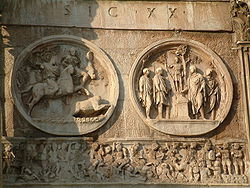
This is an image of the Battle of the Milvian Bridge from the Arch of Constantine in Rome, commissioned by the Senate fairly soon after the battle.
Source:
Wikipedia
This image was erected by the Roman senate under the banner of the Unconquered Sun. Many people point to examples like this and others where Constantine (or references made by/toward him) mention the Sun. It is quite important to remember that Constantine and the early Christians utilized aspects of pagan images, but at the same time clearly pointed to Christ as their "Lord."
Constantine and Licinius also entered something of a truce, putting an end to the leadership strife that had existed for the previous 20-25 years. Licinius later begins to persecute Christians in the east while Constantine was showing them favor in the west. This led to a final conflict, when in 324 AD the truce ended, Constantine defeated Licinius in battle and became the sole ruler of the Roman empire.
The Church Divided
As with prior times of persecution, schisms developed in the church regarding how to deal with those who had "lapsed" in their faith (see the discussion on Second Repentance, Second Century). In the East, where the persecution had been most severe, there tended to be a more lenient treatment of those who had failed in some way. In the West, especially in North Africa, a more strident view held the day. While some bishops had been able to satisfy the authorities with copies of Gnostic works to be burned, in some parts of North Africa handing over any document to be burned (even a medical book) was considered apostasy - even the appearance of cooperating was to deny the faith.
Donatus and Donatism
In Carthage a dispute arose around the bishop Caecilian who had been consecrated by a traditor (a "betrayer"), someone who had either made sacrifice to the emperor or had delivered books over to the authorities to be burned. More was involved in this situation, but during this time a man named Donatus was moving around the region of Numidia rebaptizing priests who had lapsed and giving them commission to preach and administer the Eucharist again. In previous times of persecution it had been determined that it was not necessary to rebaptize people, even if they had been baptized into a less than orthodox sect. But here Donatus was doing this within the region of a "catholic" bishop, and without authority. It caused a great stir.
The more strident movement of believers following Donatus would not accept the sacraments from someone who had lapsed during persecution. The Numidian bishops called a council in 312 and deposed Caecilian, but the controversy was not over. Shortly after this local council, Constantine ruled in favor of Caecilian and his appointees. The Donatists appealed to the emperor for another council to decide on the controversy, asking that he get bishops from Gaul who had not been involved in persecutions. Constantine granted this request and had Miltiades, the bishop of Rome, as the head of the council.
This council decided in favor of Caecilian, but the Donatists appealed on the grounds that Miltiades had been initially appointed by Marcellinus, who had also lapsed during persecution. Constantine relented, calling for a larger council to meet at Arles, hoping to put the issue to rest. Constantine attended the Council of Arles along with thirty-three bishops (three from Britain) and passed various canons, or judgements - again Donatus was condemned for his actions. After the Donatus issue the canons mostly dealt with the date to celebrate Easter, regulations regarding clergy moving from one region to another, and they decided that the churches would not rebaptize the lapsed or those who came from heretical sects.
In the end, Donatus and his churches continued, and kept growing. The Donatist movement continued into the fifth century. [You can read a more detailed account of the Donatist crisis and the actions taken by Constantine.]
Arius and the Arian Controversy
The story of Arius, like that of Donatus, begins in the fire of Roman persecution and how to treat the lapsed. During the Diocletian persecution bishops in Egypt were divided on how strictly lapsed believers were to be treated during recovery. In an Alexandrian prison Peter, the bishop of Alexandria and Meletius, a bishop from Upper Egypt, came into such sharp disagreement that they hung a curtain within the prison cell to disassociate themselves from one another. Bishop Meletius, who represented monks from the Egyptian desert, held to a fairly strict regime - Peter was seen by the Meletian group as lax.
When the intense persecution ended these men were released from prison, but their dispute continued and developed into a significant church problem. A well-educated and charismatic man named Arius rose up in the Meletian ranks, even being excommunicated by at least two councils for his support of Meletius. In a strange turn of events, Peter was again arrested and martyred. In the aftermath Arius began to argue in favor of the "catholic" side and was eventually ordained to be a presbyter by Peter's successor. The Meletians considered him like a traditor (a "betrayer") and wanted to defeat his influence - Arius had begun to build a reputation as a scholarly orator.
The Origenist Controversy - Part II
We have only touched on the controversy that revolved around some of the writings of the great Alexandrian father, Origen [see the introduction to Origen, and the introduction to the trinity which also flows from Origen's thought]. The conflict with Arius brings Origen back into the picture - this conflict is the first major theological struggle over the definition of the trinity and is the main reason Emperor Constantine called the first "catholic" council of church leaders, the Council of Nicea in 325 AD.
After Origen's death, church leaders and thinkers continued to struggle with the concepts of how the Father and Son fit together. Following the transcendence of Clement and Origen, Arius held that the only "unbegotten" being was the Father, thus no other creature was like Him. Jesus, the Son, was begotten, so Arius maintained that the Son was created. If he was created, then "there was a time when he was not," there was a time when the Son did not exist. THIS was his undoing. The Meletians demanded that Arius be disciplined - a council was called in 318 AD - one hundred bishops attended and condemned Arius to be exiled. By the time we get to the Nicean Council a true struggle for power was taking place in Alexandria. The Arians had established their own churches and their own leaders - two separate churches (denominations) had already started to develop in Egypt. This was a situation that Emperor Constantine would not accept.
Emperor Constantine and Faith
To understand Constantine's role in Christianity, you must understand how he viewed the Church. It is important to realize that Constantine always pushed for peace and unity in the church. He was not as concerned with the theological or doctrinal issues as he was to push for unity. We will see later in the discussion on the Council of Nicea that unity was Constantine's goal - the theological debate was not his major concern.Constantine has been attacked within Protestant ranks since the middle of the Reformation. I have provided several articles on Emperor Constantine meant to help the reader gain a better historical context of the man.
Constantine, Faith and the Sun God
Many critics of Constantine maintain that his actions towards the Church were motivated by his political aspirations. It is commonly asserted that his Christian profession was not genuine, and that he continued to worship the Sun. The records actually show that Constantine seemed to act in genuine Christian charity while at the same time continuing to embrace various aspects of Sun worship. But it must also be remembered that prior to Constantine early Christians had already co-opted aspects of Sun worship.
Clement of Alexandria portrays Christ, like the Sun-god, racing his chariot across the sky. Many pagans accused the Christians of Sun worship because they met on Sunday mornings - the early Christians did this to celebrate "the Lord's Day" as opposed to the Jewish Sabbath. Early in the fourth century the birthday of the Sun-god was co-opted as the day to celebrate the nativity of Jesus - there is no clear record of who started this tradition.
Considering these facts, perhaps it is less striking that Constantine continued to use the Sun on his coins and other imperial emblems. It was very clear, however, from his various letters that he considered himself a Christian and the imperial leader of the Church. It is true that Constantine was not baptized until he lay on his death bed, but this was not uncommon due to the issues of second repentance. The record on Constantine, like that of all Christian history, is mixed. We will see more of his Christian faith in the discussion of the Nicean Council.
Numerous CH101 readers have written to me with questions and critical comments about what I have written regarding Emperor Constantine. There is a significant percentage of conservative Protestants who believe Christianity suffered greatly under Constantine. As a young man I was taught that the Catholic Church started with Constantine and was the beginning of Christianity losing its way.
One reader expressed it very close to how I learned it as a young man:
Emperor Constantine comes to Power
Emperor Constantine and Christian Faith
Emperor Constantine at the Council of Nicea
Emperor Constantine and Worship of the Sun (Sol Invictus)
Emperor Constantine and Christians in the Military
Emperor Constantine Against the Donatists
The Council of Nicea - 325 AD
There are many erroneous things said and written about the famous Council of Nicea. For example, it was not:
- the beginning of the "Catholic Church"
- when Christianity decided Jesus was divine
- when the New Testament was made official
There was not exactly a vote on the trinity. No vote on the official biblical text. No vote on gnostic gospels. Christianity was not made the official religion.
The goal here is to report what the sources tell us about this historic council.
Our historical voices for most of our knowledge of this council are Eusebius of Caesarea, Sozomen, Rufinus and Theodoret of the fifth century, each of whom lean heavily on Eusebius. Eusebius was seen as a friend of Constantine and thus not seen as 100% objective in his reporting. Sozomen, Rufinus and Theodoret are writing many years after the event - there is likely to be some exaggeration, but unless there is good evidence to the contrary, it is my position that we should basically trust these historians.
Some have referred to this council as a "treaty," as if Constantine came to some kind of formal agreement with the Christian bishops, thus the "Treaty of Nicea." To my knowledge, none of our sources refer to this historic meeting in these terms.
Constantine's role in the Council of Nicea
In 324 AD the temporary truce between Licinius and Constantine came to an end. Constantine defeated Licinius in battle and became the sole ruler of the Roman Empire. Almost immediately Constantine began receiving reports that the bishops and churches in Egypt were in disarray. He had been told about the conflict between Alexander, the bishop of Alexandria, and Arius, a presbyter.
Constantine had begun to see himself as something like Plato's philosopher-King, the emperor who was also the spiritual leader of the Church. He had tried to help solve the Donatist crisis and now he was distressed with the Arian crisis in Egypt. He dispatched Hosius, a bishop from Spain, to try to reconcile Alexander and Arius. In addition, Constantine determined to call a "worldwide" council to bring peace to the Church.
Messengers were sent all around the empire, inviting (or directing) bishops to come to a monumental council. Initially the council was slated to be in Ancyra, but Constantine moved it to his summer retreat in Nicea. Around 220 bishops attended, mostly from the eastern churches. Only around eight officials came from western churches - Rome sent only two presbyters.
The council began with a solemn ceremony in the great hall. The bishops were all seated in rows of chairs lined along the walls. There was a throne at one end of the hall, obviously for emperor, and a small fire pit, like an altar, sitting in the middle of the hall. An attendant entered, then another, then a third. Then one of the attendants gave a sign and all of the bishops stood. Emperor Constantine entered the hall clothed in purple. A very tall man with a huge head, Constantine moved with the ease of an athlete-warrior. He walked with his gaze slightly downcast to the ground which seemed to indicate an imperial air combined with a kind of humility. Once Constantine reached his seat he looked around wanting the bishops to be seated. The bishops motioned for the emperor to sit first, a show of respect. Finally, Constantine seated himself with the bishops following his lead.
A statement was read (perhaps written by emperor) welcoming the bishops and rejoicing that the empire had come to peace. Now it was the intention of the emperor that the Church of the Lord be filled with peace. Rufinus records that Constantine had an attendant bring in an armful of scrolls and letters sent to him from all over the empire. It was announced that these communications were letters of accusations and complaints sent by bishops against other bishops. Constantine then let the bishops know that he had not read any of them and instructed his attendant to burn them on the altar, saying that he wanted all grievances settled during their council.
As the council progressed it became obvious to the bishops that Constantine understood Greek. He nodded as bishops spoke and even interjected comments into the air from time to time. According to Socrates, Constantine chided bishop Acesius for his rigid stance (related to second repentance), saying "Place a ladder, Acesius, and climb alone into heaven." It impressed the bishops to see that the emperor was engaged and appeared to follow the various theological and doctrinal discussions.
Theological Debate
It is clear in retrospect that Constantine was more concerned with attaining peace and unity in the Church than he was with theology or doctrine. Three men who had been excommunicated in a previous smaller council, including Eusebius of Caesarea, were readmitted with little debate. These men had been disciplined for their views on the relationship of Jesus to the Father - the same issue which had driven Constantine to call the Council of Nicea to decide what to do with the views of Arius. Eusebius was allowed to read a simple baptismal formula for his defense which Constantine urged the bishops to accept without debate.
Despite the urging of emperor for peace, accusations were thrown about and Arius was called upon
to present his views and defend himself. As Arius explained his position on the nature of Jesus some of the bishops actually plugged their ears, unwilling to listen. In the end a vote was taken to decide if Arius was to be allowed to remain in his position - it was a unanimous vote against Arius with two bishops abstaining. The views of Arius were condemned. It is important to realize that this vote was not a vote on the divinity of Jesus, or the trinity, but specifically on the views of Arius and whether or not he would be allowed to stay in his position.
Constantine insisted that the term homoousias be used in a creedal formula from the council that would definitively state the universal position of the Church. Some have stated that Constantine pushed for this term being influenced by the pro-Origenists. It must be remembered that homoousias had been used some 70 years prior by Dionysius of Alexandria in his trinitarian debate against Dionysius of Rome. It was NOT a new term. The use of the term had been marginalized because it was not found in the NT scriptures. Lietzmann calls this "amateurish theology" on the part of the emperor, but admits that the term had previously been employed not only by Dionysius, but by Paul of Samosata as well.
Here is the important thing to remember: the Church was attempting to bring clarity to the issue of exactly how the nature of Jesus was related to the nature of the Father. This had always been simply stated as in John's gospel, "In the beginning was the Word. The Word was with God and the Word was God" - Logos theology. The problem was always in the explanation. We have seen at various points how writers of the first few centuries had affirmed these concepts more simply: see the section on Ignatius of Antioch for a good example. When men like Paul of Samosata or Arius espoused anything that did not seem to fit the established understanding, others would argue against them and definitions were pushed further. One might wish that everything could be simple, but in the end the great thinkers of the Church were trying to understand and explain what has always been considered a mystery. How could God take on the form of a man...and die? For some it seems to go against logic.
In the end the teaching of Arius was condemned, a creed was drafted (with perhaps too much attention on the views of Arius), and some 20 canons were passed. Among the more important canons were an agreement of when to celebrate Easter and more regulations on how bishoprics were to operate.
The Date of Easter
When to celebrate Easter, the resurrection day of Jesus, had always been somewhat controversial. Eastern churches had always followed the Jewish calendar, celebrating on the Sunday following Passover. The Western churches followed the Roman calendar which could never be matched exactly with the Jewish calendar which added a lunar month every four years or so determined by the Sanhedrin. Thus, the Western church Easter celebration had a different cycle with fixed dates set by regional leadership. The canon from Nicea made it forbidden to "celebrate with the Jews," pointing to the undercurrent of anti-Jewish sentiment we have seen in earlier centuries.
Canons on bishoprics had been given a good deal of attention at the Council of Arles and at almost every council we have recorded. Now Nicea continued this tradition. Indeed, with Meletius and Donatus appointing their own bishops and other contentious and dubious appointments, the "orthodox" bishops saw this as an important part of governing the growing church. For example,
Canon 5 - provinces should honor excommunications pronounced by other bishops in other provinces
Canon 6 - gives the bishop of Alexandria authority over bishops in Libya and other local provinces
Canon 10 - no lapsed believer should be ordained
Canon 15 - ordained leaders shall not move from city to city on their own accord
The Nicean Council Closes
On July 25, 325 AD Constantine called for a fairly festive banquet to close the council. Constantine had already gifted several bishoprics with funds and buildings prior to Nicea, but now he showed more generosity, bestowing funds on many bishops in the great hall. Constantine went around the hall greeting bishops, kissing many on the very wounds that had been caused by Roman persecution. He gently kissed stubbed fingers that had been hacked off; he kissed empty eye sockets where eyes had been gouged out. He asked for bishops to remember him in prayer. He urged the bishops to retain and hold firmly to the peace that had been attained at their great council.
Though the emperor was filled with great optimism, many bishops were not as thrilled. A novice in the faith had pushed for a creed that had contained a key non-scriptural term and had not been well thought-out. It was also clear that the Church now was under a certain amount of governmental control. Where bishops had been excommunicated, the emperor had maneurvered to reverse those decisions, as with Eusebius. And now an excommunicated bishop could be exiled by the government. Mostly, however, bishops were thankful that their time of deadly persecution had come to an end. The theological issues addressed at Nicea were not over. In fact, even the situation with Arius would continue for another 60 years.
The Nicean Creed - 325 AD
One of the most important things accomplished at the Council of Nicea was the adoption of a creedal form that would guide the Church regarding theology, Christology, and the trinity. As has been mentioned, there was great debate about the use of the term homoousias. The creed did not have 100% approval even when it was drafted. Within a short amount of time the creed came under attack, and eventually was rewritten at the Council of Constantinople in 381 AD. [Thanks to roo.bookaroo for pointing out that I had Chalcedon here...yikes!] This is the text of the original version of the creed:
The Original Creed of 325 AD
We believe in one God, the Father Almighty, Maker of all things visible and invisible.
And in one Lord Jesus Christ, the Son of God, begotten of the Father [the only-begotten; that is, of the essence of the Father, God of God], Light of Light, very God of very God, begotten, not made, being of one substance with the Father;
By whom all things were made [both in heaven and on earth];
Who for us men, and for our salvation, came down and was incarnate and was made man;
He suffered, and the third day he rose again, ascended into heaven;
From thence he shall come to judge the quick and the dead.
And in the Holy Ghost.
[But those who say: 'There was a time when he was not;' and 'He was not before he was made;' and 'He was made out of nothing,' or 'He is of another substance' or 'essence,' or 'The Son of God is created,' or 'changeable,' or 'alterable' - they are condemned by the holy catholic and apostolic Church.]
At the end of the original creed was added the text above - obviously aimed at Arius.

Questions, Comments or Criticisms:
You can send an email to directly to me Al Baker, CH101.
CH101 retains the right to edit and post comments/questions unless you specifically ask that your comments NOT be posted. Comments that are personal or private are never posted...only questions about Church History, the Bible, etc.
