

CH101 - The Second Century
The Persecuted Church, 90 - 202 A.D.Persecution of Roman Empire
The Apostolic Fathers
The Spirit of Martyrdom
Second Repentance
Second Century Heresies
The Apologists
New Testament Canon, Part 3
New Testament Canon, Part 4
Summary and Applications
Clement of Rome
Ignatius of Antioch
Polycarp
Marcion
Justin Martyr
Irenaeus of Lyons
Clement of Alexandria
Tertullian
The Initial Heresies and Heretics
Typically when early church heresies are discussed it is in the second century. There is debate among scholars as to exactly when these early church heresies started, but we do not have clear literary evidence until the second century. The various heresies pushed the early church to define and articulate more clearly what it believed. The biggest danger faced by the early church was not losing believers to these groups - the danger was that the heretical groups used many of the same "sacred" texts. This was part of the struggle the early church faced when it came to which texts were accepted - what becomes known as the New Testament "canon" (or rule) for which texts are "inspired" and which were not.
These are not the ONLY early heresies, but these are the main ones that demanded attention from the early Christian writers.
Docetism
Beginning with the apostle Paul, the leaders of the early church had to address wrong headed ideas that threatened the integrity of the gospel message. One of the first, docetism, was mentioned in our discussion of the first century. Docetic, which comes from the Greek word meaning "to appear." Those who proposed this heresy maintained that Jesus really did not possess, or inhabit a physical body, but only "appeared" to have a body. The basis of docetism is that Jesus was truly a spiritual being, and as such, could not have had a true body.
There are aspects of the New Testament that suggest docetism was already a problem in the first century. Some scholars believe John's gospel contains some anti-docetic texts, for example in chapter 21 where Jesus eats fish with disciples. It seems that 1 John may have been written to combat this heresy, "...every spirit that acknowledges Jesus Christ come in the flesh belongs to God." 1 John 4:2
As was mentioned in an earlier section (Century 1, page 9), Ignatius of Antioch is clearly writing against docetics when he says, "He was then truly born, truly grew up, truly ate and drank, was truly crucified, and died, and rose again." Philippians 3
It is important to make a few comments regarding the heretics we are about to mention. Most heretics in early Christianity had positions of influence within the Church prior to being labeled a heretic. As Christian theology developed, becoming more and more defined, heretics were increasingly isolated and named more quickly.
I am not meaning to say that the following people were improperly accused, but it is important to understand that some heretics of the past would not have been considered heretical earlier...or sometimes later in history. Montanus (mentioned below) would be accepted in many Christian Protestant sects today without too much concern.
Marcion
Around the year 85 Marcion was born, the son of a bishop. He traveled around the world as a merchant and moved to Rome around 135 where he became known in the church and began to teach.
Marcion observed the vast differences between the God represented in the Old Testament and the God of Jesus in the NT. His answer was to reject the God of the OT, seeing him as the evil craftsman (gk. demiurge) creator of an evil world. Marcion constructed a list that represents the first recorded listing of NT texts, basically his personal canon - he excluded the entire OT, and included only Paul's letters and Luke's gospel. He also excluded a few parts of Paul's letters - anything where Paul refers to the OT in a positive way (Marcion claimed these had been tampered with by Jews) and references to hell and/or judgment (for example 2 Thess 1:6-8). It is this unorthodox canon that leads the church fathers to begin naming the "accepted" documents.
Marcion's influence was significant enough for his teaching to be argued against by several church fathers including Justin, Irenaeus, Clement of Alexandria, Origen, and Tertullian. He worked hard as an evangelist and the Marcionite churches spread throughout the Roman world. Marcionite churches held strong until the beginning of the fourth century.
Montanus
Sometime in the 160's on the borders of Mysia (western Turkey) a believer named Montanus broke onto the scene. He testified that he had experienced an ecstatic visitation of the Paraclete (the Holy Spirit) and, along with two women (Maximilla and Priscilla), had the ability to deliver prophetic messages from God.
The Montanist message, whether spoken or delivered in ecstatic utterance, consisted of: the promise (or warning) of the immanent return of Jesus and the apocalyptic end of the world, a new outpouring of the Spirit announcing this message, and an encouragement to embrace persecution and martrydom. The church had not discouraged these messages up to this point, and indeed, did not immediately disagree with Montanus. Unfortunately, other messages existed behind these to form a three-part subtext. First, two of the primary characters were women. There are some modern scholars who seize upon this as evidence for a patriarchical stronghold that would deny any leadership to women. There are good arguments against this position, but the early church was a male dominated movement and women certainly did not have equal access to leadership roles. Another subtext was the over-zealous approach to martrydom. We have already covered the problems with what can be called "the cult of the martyrs." It is highly likely that Montanists were among the martyrs in the famous persecution scene of Lyons in the year 177. Probably the most problematic aspect of the Montanists was the view that their prophecies carried the authority of the gospels, and of apostolic teaching. Montanus and his two prophetesses did not see themselves in need of the authority of the church. The leading bishops did, however, prevail even after Tertullian defected from the church and joined the Montanists. Around 179 AD Maximilla complained of the treatment she had received, "I am driven as a wolf from the sheep. I am not a wolf. I am word, spirit and power." (Eusebius, History V.16.17)
In the end, Montanism was rejected more for being fanatical than for being heretical. David Wright concludes his study on Montanism by saying, "The reaction against Montanism brought upon the church impoverishment more detrimental than the upset caused by the unbalanced excesses of the New Prophecy." (Wright, David, "Why Were the Montanists Condemned?", Themelios 2:1, pp.15-22; also www.earlychurch.org.uk/article_montanists_wright.html)
Gnosticism
In the early second century a strange movement began to emerge, more strongly concentrated in Egypt, but with pockets of activity throughout the Roman world. Gnosticism was a curious synthesis of Jewish apocalypticism, Platonism, strains of pagan religions, and early Christianity. There are some indications of an early form of first century gnosticism in the NT, but nothing like what developed in the second century. Some scholars want
to date various NT documents into the second century based on the apparent references to gnosticism.
| To better understand Gnosticism, it is helpful to read the documents that represent the beliefs of Gnosticism. Our primary documents are found in a collection known as "The Nag Hammadi Library" (NH). The NH texts include The Gospel of Thomas, The Gospel to the Egyptians and many others. Some of these documents are actually more Christian than gnostic, but others are decidely gnostic, like "To the Egyptians." See a photo on the right showing a text from The Gospel to the Egyptians in the NH in English. The reader is supposed to sound out the long vowels sounds given in the text. To better understand Gnosticism in the ancient world, download the paper: A Brief Introduction to Gnostic Writings. | 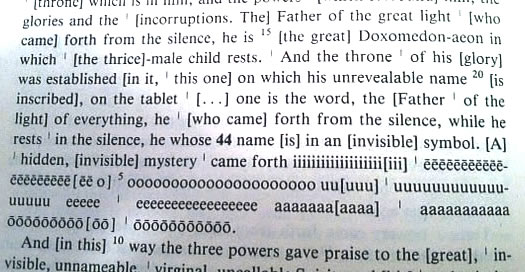 |
Similar to Marcion, basic Gnosticism consisted of an extreme dualism, drawing a distinction between the body and the spirit realm. The "demiurge" was the evil creator of the physical universe, humans were bound in their "evil" physical body, and could only be released from the confines of that body through the gaining of gnosis, or divine knowledge. The seven visible heavenly bodies (Sun, Moon, Mercury, Venus, Mars, Jupiter, and Saturn) gave rise to a belief in eight heavenly realms. Plato had written about the concept of pre-existent souls in a state of perfection prior to taking on a mortal body on the earth. When the soul is released from the prison of the body it ascends back to the heavenly realm where it is reunited with the realm of ideas. The soul in the Gnostic system must ascend through these heavenly realms in the quest to return to a state of perfection. Along the way the soul must pass guardians of each level; typically to pass into the next stage, or heavenly realm, the soul must recite some of the heavenly gnosis learned during the earthly trek. The eighth level is the place of perfection, the ultimate goal for every soul.
Gnosticism in the second century was not a unified movement. Each group tended to gravitate around a single enlightened leader, and most groups were exclusive, seeing their particular set of dogma to be unique and essential. This lack of cohesiveness between Gnostic sects makes it difficult to quickly summarize the gnostic system beyond the above overview. To learn more, see the explanations regarding some of the chief gnostics of the second century:
Carpocrates
Basilides
Valentinus

Questions, Comments or Criticisms:
You can send an email to directly to me Al Baker, CH101.
CH101 retains the right to edit and post comments/questions unless you specifically ask that your comments NOT be posted. Comments that are personal or private are never posted...only questions about Church History, the Bible, etc.
top of page |
go to page 6 - The Apologists
Questions/Answers
Ask Your Questions
Part of what drives the CH101 website is attempting to answer questions from our readers.
Send your question directly to Dr. Baker's InBox.
We will do our best to give you an Answer...
And that helps grow our website!
An Intro to Gnostic Writings
| - CH101 All rights reserved. |
1st Century | 2nd Century | 3rd Century | 4th Century | Resources | Podcasts | Survey | Site Map |