



CH101 Book Reviews
Did Jesus Exist?
The Historical Argument for Jesus of Nazareth
by Bart Ehrman
Without question this is my favorite Ehrman book. I must admit that I have only read one of his academic works. I used his Introduction to Biblical Studies in a class I taught at Troy University in Alabama. I have read four of his more popular works.
Generally speaking I like Ehrman's work. While I have disagreements with his presentations, I do think he is pushing some needed arguments which is why I read him and write these reviews. When I say this is my favorite Ehrman book it is not solely because it agrees with my position - this is a great introduction to the earliest documentary evidence for the life of Jesus. There are many points of data that a conservative/evangelical Christian might disagree with, but it is good to at least hear and think about the data.
Ehrman tells the reader up front:
"I know that some readers who support agnostic, atheist, or humanist causes and who typically appreciate my other writings will be vocal and vociferous in rejecting my historical claims. At the same time certain readers who have found some of my other writings dangerous or threatening will be surprised, possibly even pleased, to see that here I make common cause with them."

Prof. Bart Ehrman, UNC Chapel Hill
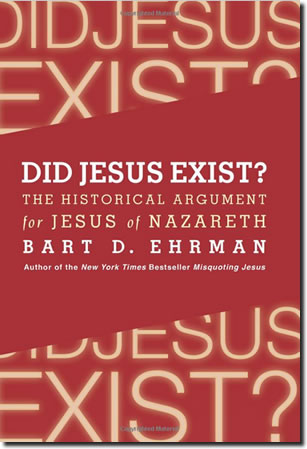
Purchase the Book
I guess I am one of the latter, except that I do not see Ehrman's work as "dangerous or threatening." On the contrary,
I appreciate what Ehrman is doing and I think conservative/evangelical scholars and Christians who interact with critics of our faith need to grapple with his ideas and the data he presents. I just heard from a young man taking an NT class at university - his textbook is an Ehrman text. Evangelicals ignore this man at our own peril; many young people have heard his ideas and we need to have good answers to his objections. Historical data is never dangerous for our faith - some of Ehrman's interpretations of the data (at least in his popular books) are skewed in my opinion, but I would not call him "dangerous" unless a young person accepts his work without question and without reading critical reviews like mine.
Ehrman consistently addresses points made by "mythicists," those who do not believe the man known as Jesus of Nazareth even existed. They believe this whole Jesus (Christian) message was fabricated for socio-political, and maybe even some religious reasons - for them the whole thing is a myth.
Chapter 2: Non-Christian Sources
Ehrman rightly points out that ancient history is like putting a puzzle together knowing that we do not have ALL the pieces. Critics of the New Testament and the mythicists argue that the only historical data we have for the life of Jesus are the NT documents. Ehrman cites one example (p.44) to illustrate why this is a pessimistic way of viewing history and leads to a skepticism that is just not reasonable. We read about Pontius Pilate in the NT gospels and how he presided over the arrest, punishment and trial of Jesus. We learn from the Jewish historian Josephus that Pontius Pilate ruled Judea for 10 years, from 26-36 A.D. As Ehrman points out, Josephus is the only significant historical record of Pilate outside the NT documents. (Antiquities XVIII.3 and 4) Philo the Jew mentions Pilate and (as Ehrman tells the reader) Tacitus names him in passing - "And what is striking is that we have far more information about Pilate than about any other governor of Judea in Roman times." (p.45) This is unfortunately how we find ancient history - we do not have as much data as we would like which often leads to an abundance of speculation.
Ehrman deals with each of the non-Christian texts where we find reference to Jesus of Nazareth. The mythicists discount almost all of these documents, claiming each text was edited/redacted by later Christians to support the myth of Jesus. The reader will appreciate Ehrman's presentation here as he gives arguments against the conspiracy claims of the mythicists.
• Roman Biographer, Suetonius
• Roman Historian, Tacitus
• Jewish Historian, Josephus
While some of these documents were obviously edited, Ehrman gives solid scholarly reasoning for why these documents must still be considered as historical evidence.
Chapter 3: The Gospels as Historical Sources
Ehrman's treatment of the historical background for what becomes the NT gospels is well done. (Ch 3, pp.69-93) This chapter, in my opinion, is the most important section of this book. In brief, Ehrman shows the high probability that all four NT gospel writers had other sources for their work, both written and oral. In this section Ehrman reports what is generally agreed upon by most NT scholars: there is probably some kind of source (written and/or oral) behind each NT gospel account. Scholars refer to Matthew's main written source as "M," Luke's main written source as "L," and so forth. Ehrman does not list the prior source for Mark but he does give "J" for John. He also reminds the reader that most scholars believe there was a "Q" source that is attested to in Matthew, Luke and the Gospel of Thomas.
To be clear, what Ehrman presents here is a theory. Historians must take the existing data and try to fill in the gaps from missing pieces. What Ehrman does here that I have not seen before is to clearly explain the position that not only do the synoptic writers have a prior source, but that each one appears to have had either an early written or oral source. This is a commonly held position, but Ehrman does a very good job of laying out the basic data. One of my favorite NT scholars, F.F. Bruce, presents this position regarding Aramaic sources behind Luke/Acts (Men and Movements), but Ehrman's presentation here is excellent.
I invite you to watch this YouTube debate (below) on MSS integrity between Bark Ehman and Daniel Wallace. These two men are probably in the top 10 MSS experts in the world. This is over two hours in length, but if you watch it at 1.35x you can watch it more quickly.
Academically Ehrman's strongest arena is MSS (manuscripts) tradition. He studied under the famous
Bruce Metzger at Princeton and has several published works in this field. Ehrman is a self-proclaimed agnostic.
Wallace is a professing Christian and has been throughout his career.
You need to know that these two scholars are also good friends. One is a confessed Christian and one is agnostic...they
go at each other in debate and are friends when they leave the auditorium.
"To dismiss the Gospels from the historical record is neither fair nor scholarly." p.73
Although I am happy to read this comment, it is one of my loudest complaints while reading this book - unlike what he has done in previous books, Ehrman presents the NT gospels as credible historical documentation and evidence. As I have argued in other reviews, Ehrman consistently gives more historical credibility to extra-biblical texts than he does the NT texts. In other writings Ehrman consistently sounds like he does NOT view the NT gospels as historical evidence, yet in this book he brilliantly presents the argument FOR reading the NT gospels as historical data. One might say (indeed, my bet is that Ehrman would say this) "This is just your perspective. You brought a critical attitude to the other books while you are reading accurately in this book because you agree with Ehrman here." This is certainly possible, but reviews from mythicists say the same thing. Nonetheless, this is a great chapter...and MY favorite chapter of ALL Ehrman books I have read.
Chapter 4: Evidence for Jesus from Outside the Gospels
In this chapter Ehrman presents the evidence from the earliest Christian writings: Papias, Ignatius of Antioch, Clement of Rome, and the various non-gospel writings in the NT. Again Ehrman presents the evidence for early Aramaic sources used in the Acts account. He also shows the independent sources for Paul's writings. Recently James Tabor has argued that Pauline writings actually influenced the early gospels (Paul and Jesus). Ehrman seems to argue against Tabor and I tend to agree with Ehrman.
There is a section in this chapter where Ehrman presents the writings of the Apostle Paul as historical evidence for the life of Jesus. This is also a good section. Ehrman walks through some of the evidence to show that Paul's knowledge of Jesus is not from the written gospel accounts. Paul tells us that his gospel came directly from Jesus, but he also tells us that he spent 15 days with Cephas (Peter) and met James, the brother of Jesus. (Gal 1:18-20) This is another good section for understanding the earliest history of the Christian Church.
The remainder of this book is good reading, but did not interest me as much. Ehrman concisely presents the arguments of the mythicists, then he presents his argument against their points.
After this Ehrman spends the last three chapters explaining how he sees the historical Jesus. He has just taken over 260 pages to explain how we can have some certainty about the historical nature of Jesus; now Ehrman gives his explanation for how he, as an agnostic historian, understands Jesus.
Chapters 8 and 9 are interesting.
In Chapter 8 Ehrman goes over the historical context in first century Palestine. The reader is introduced to the four Jewish sects current during the time of Jesus: Pharisees, Sadducees, Essenes and the group typically called Zealots (called the Fourth Philosophy by Josephus). In Chapter 9 he presents Jesus as the first century Jewish apocalyptic preacher. I believe these two chapters are instructive for any serious reader of the New Testament.
Apocalypticism was a very influential movement in Judaism from around the second century BC through the first century AD. Jesus and Paul both preached "the end is near." The serious NT reader must grapple with "why" this message was preached and then "why" the end did not appear to happen as predicted. I am familiar with the various conservative/evangelical explanations and I basically hold to the idea that the "end" was the destruction of the Temple with another "end" sometime in the future. Having said this, when one reads Jesus and Paul it certainly appears that they are not expecting this age to last until 2013. Just something to think about.
Towards the end of this chapter Ehrman makes the kind of statement that seems inconsistent with how he operates in other instances. He says that we cannot trust the accounts of the trial of Jesus since we have no eyewitness from the trial. (p.330) He makes this statement even though the trial is attested in every gospel and has the evidence of dissimilarity (please correct me here if I am wrong). If every gospel tradition records the trial, it could be that an eyewitness to the event later becomes a believer...like Nicodemus. Nicodemus may have been a pseudonym for such a person. Hard to think all the gospel writers who seemed to stick close to their sources would fabricate this important event.
The Conclusion is quite interesting and entertaining. Ehrman exposes the "mythicist" attacks as something of an emotionally-based "bee in their bonnet" as the Scots say. He urges this agnostic/atheistic group to stick to good history. What's the point of attacking religion all the time?
From page 335,
Jesus would not recognize himself in the preaching of most of his followers today. He knew nothing of our world. He was not a capitalist. He did not believe in free enterprise. He did not support the acquisition of wealth or the good things in life. He did not believe in massive education....He knew nothing of social security, food stamps, welfare, American exceptionalism, unemployment numbers, or immigration....Jesus was a first-century Jew...
The point of the quote above appears silly to me at its foundation. i believe Messiah came in semi-stealth mode the first time to accomplish a mission (succeed in perfect sinless living fulfilling law which would make Him a perfect sacrifice to atone for the failure of Adam who represent[s] us all)....if one can believe He came the 1st time (i.e. He is historical), i would think it no stretch to believe He will come again as He said. i think it is more than clear all the above questions will be answered at His 2nd appearing. when He gets back, He will most certainly talk politics at length! if i read correctly, He will also kick considerable ass when He comes back (no more sweet Jesus here!). we have had so much mercy and grace from Him we think that's all He has and we would be WRONG on that idea. in the end, Justice will win the day. as 1st mission objectives dictated, the first coming required He "empty Himself" and become like those who's culture He entered at a point in time (to me, this "empty" part includes the loss of knowledge of what He left behind for His time in flesh). Since His point in coming here in human form the 1st time was not to do/validate/confirm ANY of the things mentioned in the quote above, how can those who say He failed His mission because He didn't clarify politics or do "culture fixing"? He was not here for that reason so it can't be said He "failed" in a mission He was not on at that time. if we can agree He DID come once, the question now becomes "why did He come" and "is He coming again". if we can just get together on the 1st point, at least we will be talking apples and apples with these critics for the present. the second point is another issue. maybe this is the divide between the "what He did" vs "who He is" thing....i would think the rebuttal answer to the quote above is "He didn't come to do any of those things on 1st mission, so what is your point?"
Jesus did not come back to engage in all that stuff...at least it does not seem so to me. Our transformation of Jesus, WWJD, into being concerned with everything like these issues is taking Him out of context to some degree. I think Ehrman is speaking more to the point that we need to understand Jesus in his original historical context before we start offering what WE THINK He would say/do in OUR context 2000 years later. And I agree IF this is indeed what Ehrman is saying.
I have written this several times on this site: "Jesus was a first century Jew, living under the Law speaking to first century Jews who were (or were supposed to be) living under the Law." I am not sure Jesus fully understood His mission as the reader has indicated above WHILE He walked the earth -- Jesus was a man and if Paul is giving us the right info in Philippians 2 (by revelation I am thinking), Jesus did not have His eternal nature and powers during His earthly visit.
So, we need to work to figure out what Jesus meant in His original historical context before we leap to assumptions about what Jesus would say or do in our modern era. Let's face it: He surprised His contemporaries both by what He said (and did not say) AND by things He did (and did not do). Does it not make sense that He would surprise us in our context?
In the end, I highly recommend this book for any Christian seriously interested in a deeper understanding of how our New Testament gospels came to be and a good introduction to first century Christian history. If you have never been exposed to this kind of information you might need to read it 2-3 times. I probably will.
R.A. Baker
Ph.D. Ecclesiastical History

Questions, Comments or Criticisms:
You can send an email to directly to me Al Baker, CH101.
CH101 retains the right to edit and post comments/questions unless you specifically ask that your comments NOT be posted. Comments that are personal or private are never posted...only questions about Church History, the Bible, etc.
